


Antifungal activity and action mechanism of thymol against rice blast fungus Magnaporthe oryzae
Huan Liu, Ziyi Wang, Guanfei Yu, Chenxi Yan, Yiming Liu, Shengming Liu, Shuzhen Deng
Pestic Biochem Physiol.; 2025 Dec: 215:106646. doi: 10.1016/j.pestbp.2025.106646.
Abstract
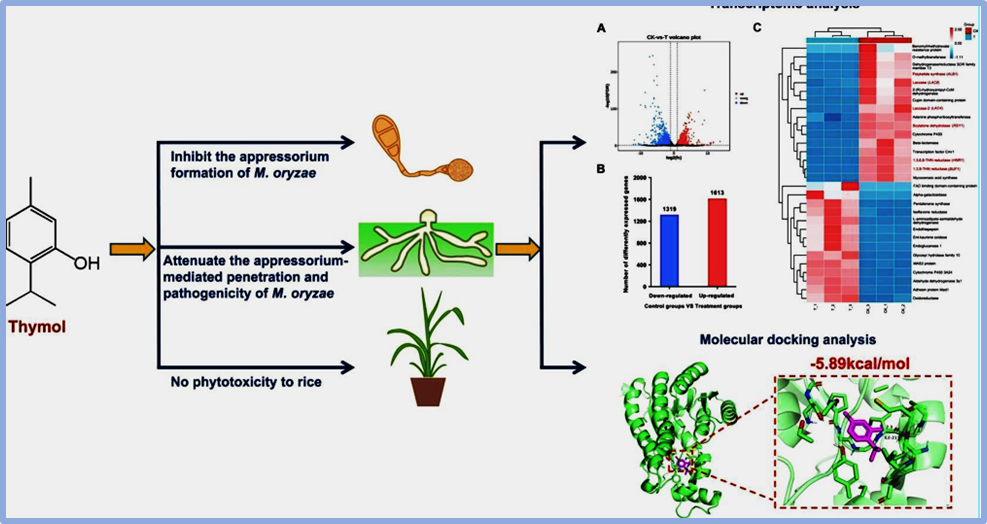
Rice blast (Magnaporthe oryzae) is one of the most devastating disease in rice. There is an urgent need to find effective and environmentally friendly chemicals for the prevention and control of rice blast. In this study, we evaluated the antifungal activities of five plant-derived essential oils: black pepper essential oil, perilla essential oil, thyme essential oil, peony essential oil, and rosemary essential oil, against M. oryzae. Specifically, thyme essential oil exhibited an excellent antifungal activity at a concentration of 1 μL/mL. To ascertain the active ingredient, the oil was subsequently analyzed using gas chromatography-mass spectrometry (GC-MS). Thymol was identified as the primary active component and antifungal assays showed that thymol effectively inhibited spore germination and appressorium formation of M. oryzae. In addition, treatment of thymol impaired mycelial micromorphology and appressorium-mediated penetration. Biosafety assays indicated that thymol exhibited no phytotoxicity towards rice. Furthermore, transcriptome analysis indicated that thymol might significantly affect melanin biosynthesis pathway of M. oryzae. This inference was further supported by preliminary molecular docking analysis of thymol with four proteins (Hnr1, Lac8, Buf1, and Rsy1) involved in melanin biosynthesis pathway. Our study provides new insights into the potential mechanism of thymol against M. oryzae.
See https://pubmed.ncbi.nlm.nih.gov/41162036/
Views: 353