


Alternaria alternata Effector Aa593 Promotes Virulence by Hijacking the CmNAC29-Mediated Abscisic Acid Biosynthesis Pathway in Chrysanthemum
Boxiao Dong, Ye Liu, Zheng Gao, Gan Huang, Fengfan Gao, Qi Wang, Zhiyong Guan, Sumei Chen, Fadi Chen, Jiafu Jiang, Weimin Fang
Plant Biotechnol J.; 2026 Feb; 24(2):887-904. doi: 10.1111/pbi.70388.
Abstract
The interaction between plants and pathogens has long been an actively researched field of plant immunity. In this study, we found an Aa593/CmNAC29-CmNCED3 module associated with the interaction between chrysanthemum and the fungal pathogen Alternaria alternata. Here, we identified a transcription factor, CmNAC29, in chrysanthemum that promotes abscisic acid (ABA) biosynthesis by directly regulating CmNCED3, a key rate-limiting enzyme gene for ABA synthesis, thereby determining the susceptibility of plants to A. alternata. On invading plants, pathogens secrete effectors that contribute to regulating plant immune responses. Interestingly, we screened a novel effector, Aa593, secreted by A. alternata that targets CmNAC29 in the plant cell nucleus. By interacting with CmNAC29 and thus enhancing its transcriptional activation activity, Aa593 promotes ABA biosynthesis and subsequently weakens plant resistance to A. alternata. Furthermore, genetic transformation assays indicated Aa593 contributes to the virulence of A. alternata. Our findings in this study have enabled us to elucidate how fungal effectors target plant hormone signalling pathways to promote their virulence and lay the theoretical foundations for further studies on the pathogenic mechanism of necrotrophic fungi.
See https://pubmed.ncbi.nlm.nih.gov/41025620/
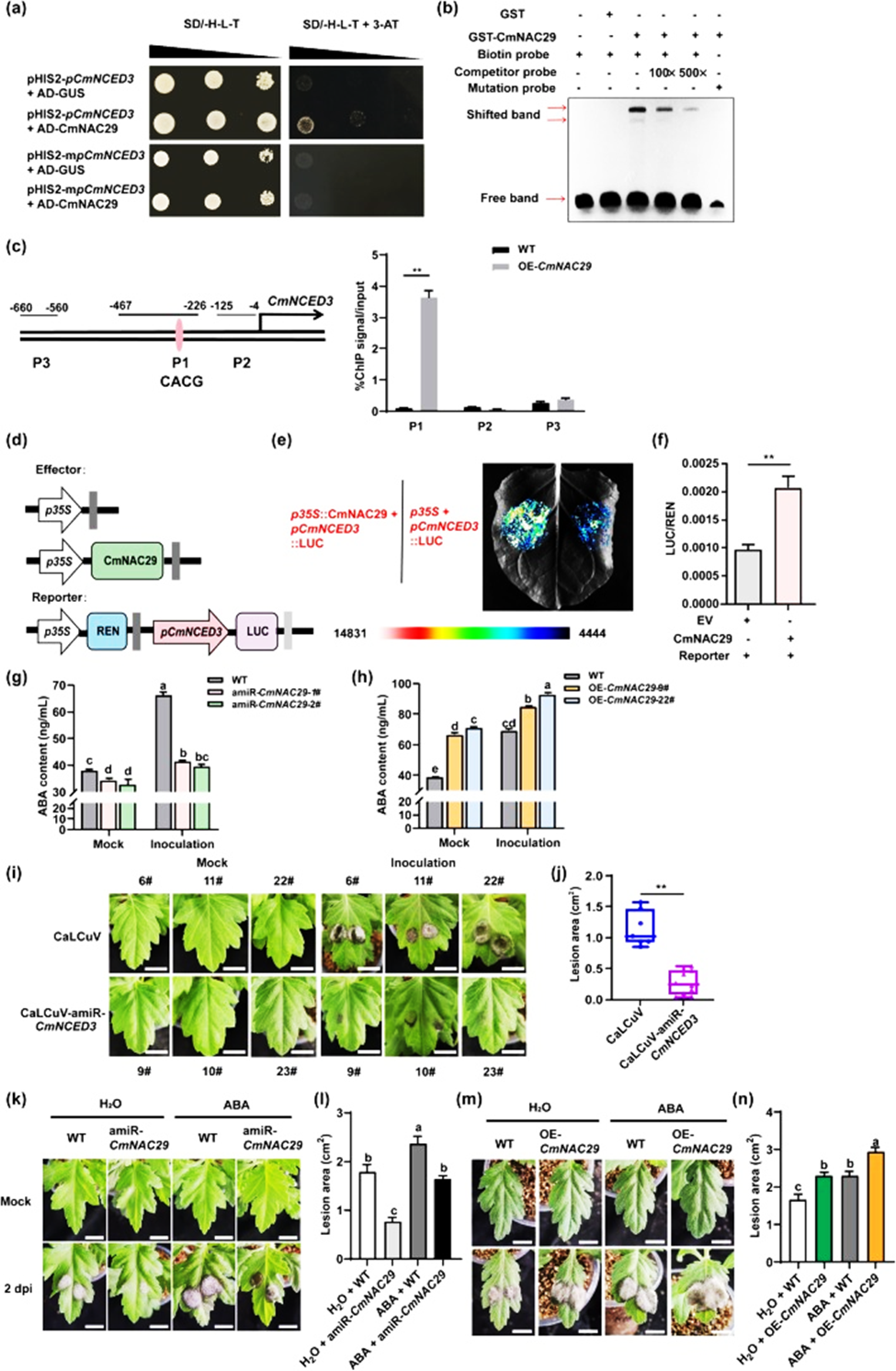
Figure 2: CmNAC29 directly activates the expression of CmNCED3 to enhance ABA biosynthesis in chrysanthemum. (a) CmNAC29 binds to the promoter of CmNCED3 in yeast one‐hybrid (Y1H) assays. AD‐GUS, a negative control; mpCmNCED3, the key binding element ‘CACG’ on the promoter of CmNCED3 is mutated to ‘AAAG’; SD/‐H‐L‐T, SD/‐His‐Leu‐Trp; 3‐AT, 3‐amino‐1, 2, 4‐triazole. (b) Results of an electrophoretic mobility shift assay (EMSA) showing the binding of CmNAC29 to the cis‐element ‘CACG’ in the CmNCED3 promoter region. (c) ChIP‐qPCR analysis in the WT and OE‐CmNAC29 transgenic plants. OE, overexpression; P1, contains ‘CACG’ element; P2 and P3, act as negative controls without any binding site. (d) A schematic representation of the effector and reporter constructs used in the dual‐luciferase reporter assays. (e) Fluorescence images of leaves sprayed with 1 mM fluorescein sodium. p35S + pCmNCED3::LUC was used as a control. (f) Luciferase/Renilla luciferase (LUC/REN) ratio values for different combinations in the dual‐luciferase reporter assay. Values are presented as the means ± SEMs (n = 3). Analyses were performed using Student's t‐test (**p < 0.01). (g) Determination of ABA content in WT and amiR‐CmNAC29 lines before and after inoculation with A. alternata . Values are presented as the means ± SEMs (n = 9). Analyses were performed using Duncan's multiple range test (different letters above bars indicate significant differences, p < 0.05). (h) Determination of ABA content in WT and OE‐CmNAC29 lines before and after inoculation with A. alternata . Values are presented as the means ± SEMs (n = 9). Analyses were performed using Duncan's multiple range test (different letters above the bars denote significant differences, p < 0.05). (i) Phenotypic observations of chrysanthemum containing CaLCuV or CaLCuV‐amiR‐CmNCED3 vectors inoculated with A. alternata at 2 dpi. Scale bars = 1 cm. (j) The lesion area analysis of CaLCuV and CaLCuV‐amiR‐CmNCED3 plants at 2 dpi. Values are presented as the means ± SEMs (n ≥ 7). Analyses were performed using Student's t‐test (**p < 0.01). (k) Phenotypic observation of WT and amiR‐CmNAC29 lines inoculated with A. alternata after pretreatment with 100 μM ABA or sterilised water containing 0.5% ethanol (as a control). Scale bars = 1 cm. (l) Statistics of the lesion area after inoculation for 2 days under different pretreatment conditions. Values are presented as the means ± SEMs (n = 14). Analyses were performed using Duncan's multiple range test (different letters above bars indicate significant differences, p < 0.05). WT, wild‐type; ABA, abscisic acid. (m) Phenotypic observation of WT and OE‐CmNAC29 lines inoculated with A. alternata after pretreatment with 100 μM ABA or sterilised water. Scale bars = 1 cm. (n) The lesion area of WT and OE‐CmNAC29 lines under different pretreatment conditions. Values are presented as the means ± SEMs (n ≥ 10). Analyses were performed using Duncan's multiple range test (different letters above the bars denote significant differences, p < 0.05).
Views: 115