


Accessing crop genetic diversity via pangenomics
Tessa R. MacNish, Venkataramana Kopalli, Silvia F. Zanini, Rod J. Snowdon, Agnieszka A. Golicz & David Edwards
TAG; March 13 2026; vol. 139; article 96
Abstract
With the increasing accuracy and decreasing cost of sequencing technology, the extent of structural variation (SV) and its importance in crop species has become increasingly evident. SVs such as insertions, deletions, and inversions have been associated with genetic variation of agronomically important traits and the diversification of crop species. Pangenomes aim to capture the genetic diversity of a species, population or genus, by incorporating the genomes of multiple individuals. The additional genetic diversity represented by a pangenome compared to a single-genome reference can aid the association of variation with traits and support crop improvement. Genus-wide pangenomes representing related crop species as well as their wild relatives can be used to identify and introduce novel genetic variation associated with agronomically important traits into crops. Pangenomes can aid crop improvement through pangenome assisted breeding (PAB) and genome editing. PAB is an adaption of marker assisted breeding that associates pangenome-based markers, including single nucleotide polymorphisms (SNPs) and SVs, with a trait of interest. Genome editing can use CRISPR/cas9 or similar tools to introduce or change the expression of agronomically important SVs. Pan-epigenomics is an emerging field that can complement pangenomics studies by identifying epigenetic modifications such as DNA methylation, histone modifications, and chromatin accessibility, which play important roles in regulating gene expression and have been shown to contribute to intraspecific diversity and agronomically important traits. We highlight the advances of crop pangenomics and their use in crop breeding and improvement.
See: https://link.springer.com/article/10.1007/s00122-026-05201-0
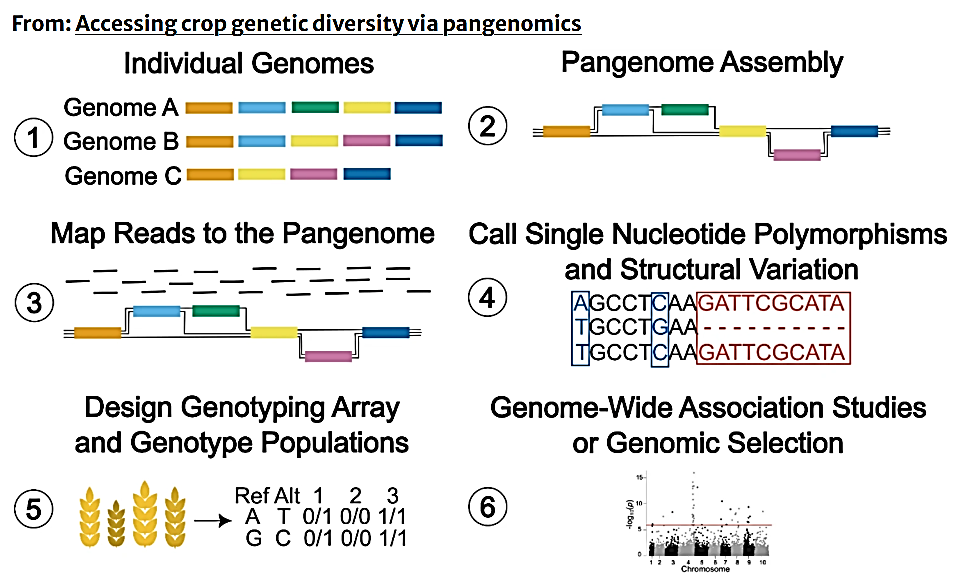
Figure 1
A workflow for the application of pangenomes for crop improvement. Genome assemblies of the crop of interest are collected and assembled into a pangenome. Pangenome-based genomic markers are identified by mapping reads to the pangenome and calling single nucleotide polymorphisms and structural variation. Once pangenome markers have been identified, they can be used to develop pangenome-based genotyping arrays. Markers identified by pangenome-based genotyping arrays can then be used in genome-wide association studies and genomic selection
Views: 155