


A sorghum pangenome reference improves global crop trait discovery
Geoffrey P. Morris, Avril M. Harder, Adam L. Healey, Chloee M. McLaughlin, Joanna L. Rifkin, Clara Cruet-Burgos, Jerry W. Jenkins, Shengqiang Shu, John J. Spiekerman, Carl J. VanGessel, Erica Agnew, Alain Audebert, Kerrie Barry, Ivan Baxter, Gregory Beurier, Lori Beth Boston, Richard E. Boyles, Siobhan M. Brady, Victoria Bunting, Jacqueline M. Chaparro, Chaney Courtney, Joseph Sékou B. Dembele, Santosh Deshpande, Cyril Diatta, …John T. Lovell
Nature 2026; Published on-line: 11 March 2026
Abstract
Although the green revolution adapted a handful of crops to homogeneous and high-input industrialized agriculture, much of the global population still relies on the local production of variable crop cultivars by low-input smallholder farms. This diversity of unhomogenized crops1, like that of the grain and bioenergy crop sorghum2,3,4,5, offers raw materials for genetic gain and cultivar improvement. However, breeding efforts can be constrained by highly specialized traits and breeding targets6. Here, to bridge this diversity, we constructed a 33-member pangenome reference and a diversity panel across 1,984 cultivars and landraces. We leveraged these resources to explore the complex interplay among historical contingency, ongoing adaptation and previously uncharacterized structural diversity. Specifically, our analyses conclusively demonstrated multiple nested and deeply diverged structural variants in the domestication gene SHATTERING1, which distinguish the previously established multicentric origin of sorghum. We then applied landscape genomics to reveal how gene flow and secondary contact created the complex genetic mosaic in contemporary breeding networks. As proof of concept for pangenome-accelerated trait discovery, we connected biosynthetic gene cluster structural variation to phenotypic leaf concentration of the cyanogenic glucoside dhurrin. Combined, these approaches will accelerate breeding and trait discovery and provide a framework for similar applications in other crops.
See https://www.nature.com/articles/s41586-026-10229-9
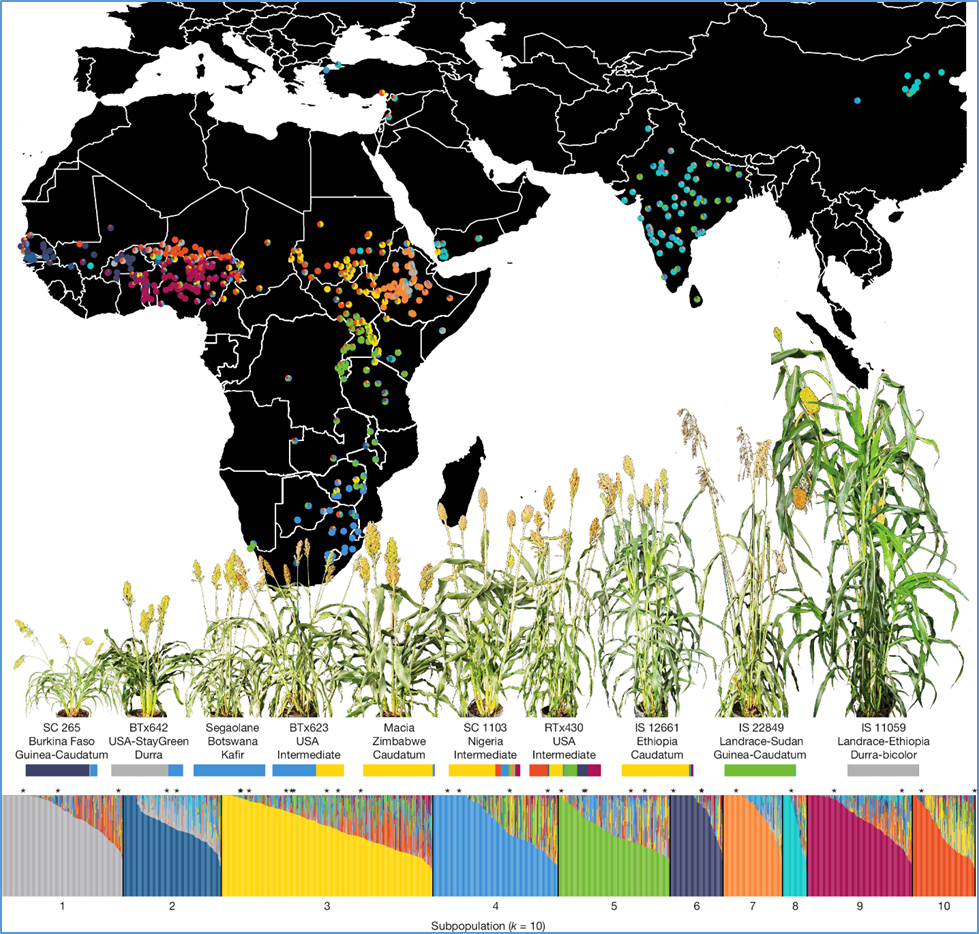
Figure 1: The whole-genome re-sequencing panel of 1,984 unique genotypes was clustered into 10 subpopulations (Supplementary Note 4). Ancestry proportions to each subpopulation are shown for all genotypes (vertical bars in the bar plot; bottom) and for the 693 unique African and Asian cultivars with georeferenced collection locations (pie charts and map; top). The 33 members of the pangenome reference are marked with an asterisk above the bar plot. Ten pangenome members that span the genetic and phenotypic diversity of our pangenome are labelled (including the country of origin and botanical type), with representative photographs (above the label) and their ancestry proportions (below the label).
Views: 137