


A MAPK cascade regulates nuclear migration during female gametogenesis to establish specific cell identity and rice female fertility
Changhao Liu, Yujing You, Xiaorong Huang, Yuanpeng Xu, Jinyang Zhang, Dongqing Shu, Guangtao Li, Shujing Li, Xin Ding, Qiuhui Yang, Juan Xu, Shuqun Zhang, and Jing Zhao
PNAS January 2 2026; 123 (1) e2426754122; https://doi.org/10.1073/pnas.2426754122
Significance
The female gametophyte (FG, embryo sac) is an essential structure for successful fertilization and angiosperm reproduction. During this process, the proper migration and positioning of eight nuclei in the embryo sac are essential for establishment of a functional FG and production of fertile seeds. However, the mechanisms underlying the precise movement of these nuclei to their predetermined positions have remained a long-standing question. In this study, we demonstrate that a mitogen-activated protein kinase cascade, comprising OsMEKK2/OsMEKK21, OsMKK6, and OsMPK4, can be sequentially phosphorylated and activated, thereby precisely regulating free-nuclear migration and determining the number and identities of polar nuclei.
Abstract
During the development of the rice female gametophyte (FG, embryo sac), there exists a free-nuclear stage wherein eight nuclei, originating from the same mother cell nucleus, respectively migrate to specific positions to acquire distinct cell identities after cellularization and develop into the egg cell, central cell, or accessory cells. Therefore, this nuclear migration stage is essential for fertilization and rice fertility. How these nuclei can find their own way to exactly move to different predetermined positions and how the two polar nuclei are selected have been intriguing questions for decades. Here, we show that a mitogen-activated protein kinase cascade, composed of OsMEKK2/OsMEKK21, OsMKK6, and OsMPK4, precisely regulates free-nuclear migration and determines the number and identities of polar nuclei. Specifically, OsMKK6 phosphorylates OsMPK4 to restrict nuclear migration at the chalazal pole, ensuring the accurate number and positioning of antipodal cells and polar nuclei. Loss-of-function mutations in OsMKK6 and OsMPK4 result in an excess of polar nuclei at the expense of antipodal cells. Additionally, OsMEKK2 and OsMEKK21 function as upstream regulators, phosphorylating and modulating downstream substrates to control nuclear migration at both poles. This regulation is essential for FG fertility and seed production. Our findings reveal a hierarchical model for the regulation of nuclear migration during embryo sac development and provide valuable insights into how an embryo sac orchestrates the migration of eight nuclei in response to different positional cues, thereby establishing female fertility in rice.
See https://www.pnas.org/doi/10.1073/pnas.2426754122
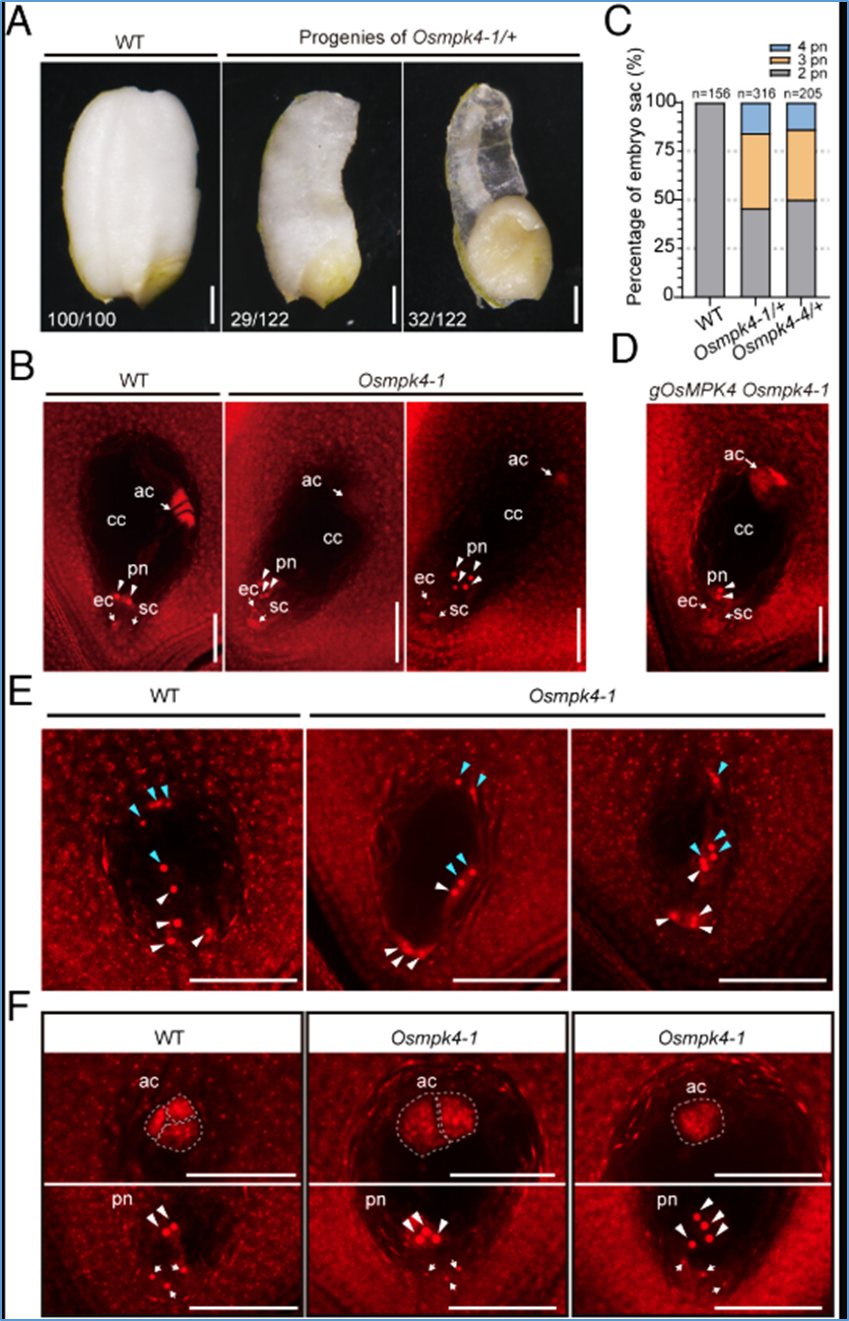
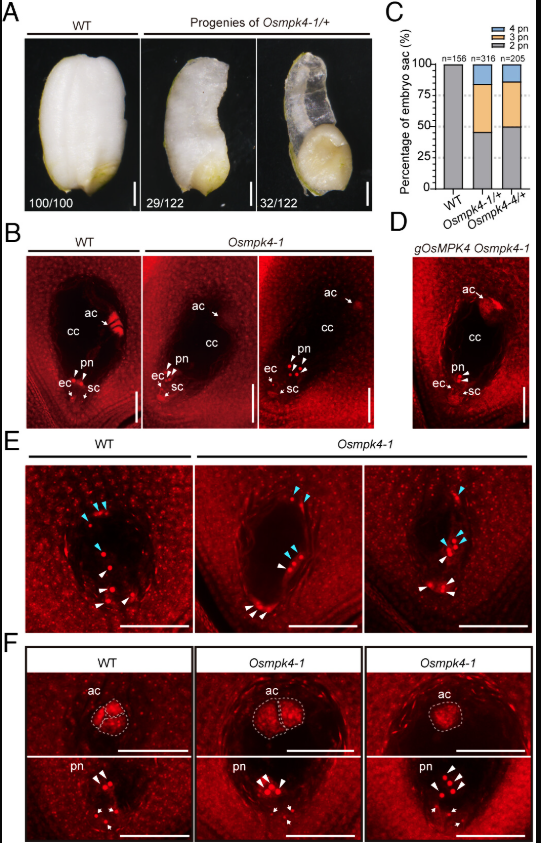
Figure 1
Loss of OsMPK4 leads to supernumerary polar nuclei in the FG. (A) Seed phenotypes of the self-pollinated wild-type plants (Nipponbare, NIP) and Osmpk4-1/+ mutants. The number presented at the bottom of each image shows the counts of aborted seeds (Left) versus the total counts of seeds assessed (Right). (Scale bars, 1 mm.) (B) Morphology of the wild-type and Osmpk4 embryo sacs at the mature stage by the WECLSM method. One or two additional polar nuclei appeared in Osmpk4 embryo sacs. (Scale bars, 50 μm.) (C) Quantitative assessment of varieties of phenotype events in the progenies of Osmpk4/+ mutants according to the number of polar nuclei. pn, polar nuclei. The number of embryo sacs (n) was 156 for wild-type plants, 316 for Osmpk4-1/+, and 205 for Osmpk4-4/+ mutants. d, Expression of OsMPK4Pro: gOsMPK4 complemented the phenotype of multiple polar nuclei in Osmpk4 embryo sacs. (Scale bars, 50 μm.) (E) Morphology of eight-nucleate coenocytes in wild-type plants and Osmpk4-1 embryo sacs. Nuclei derived from the micropylar pole are indicated by white arrowheads, and nuclei derived from the chalazal pole are indicated by blue arrowheads. (Scale bars, 50 μm.) (F) The number of antipodal cell clusters decreased in accordance with the increase in polar nuclei in Osmpk4-1 embryo sacs. (Scale bars, 50 μm.) The dashed frame indicates antipodal cell cluster; arrowheads indicate polar nuclei; arrows indicate egg cells and synergid cells. ac, antipodal cells; cc, central cell; ec, egg cell; pn, polar nuclei; sc, synergid cell.
Views: 155