


A balance between glycitein and glyceollins governed by isoflavone 6-hydroxylase confers soybean resistance to Phytophthora sojae
Qilin Yang, Yining Wang, Xindan Xu, Jia Yuan, Fengxia Zhang, Hao Qin, Shihao Li, Jianxu Li, Hao Lin, Lei Li, Zhixi Tian, and Guodong Wang
PNAS; December 11 2025; 122 (50) e2525627122; https://doi.org/10.1073/pnas.2525627122
Significance
In this study, we identified GmIF6H1 (Glyma.11g108300) as a key gene for glycitein biosynthesis in soybean, catalyzing daidzein 6-hydroxylation rather than the previously assumed liquiritigenin route. Infection by Phytophthora sojae induced glycitein release, yet both knockout and overexpression of GmIF6H1 increased susceptibility, underscoring the need for precise regulation. We further revealed a complementary daidzein-based defense strategy in soybean: glycitein-type isoflavonoids (via daidzein 6-hydroxylation) as phytoanticipins and glyceollins (via daidzein 2’-hydroxylation) as phytoalexins. These findings not only clarify the biosynthetic origin of the glycitein but also highlight its pivotal contribution to soybean pathogen resistance.
Abstract
Isoflavonoids, predominantly found in legumes, are specialized metabolites with antioxidant properties that benefit both plant resilience and human health. Using metabolic genome-wide association studies (mGWAS), we identified the cytochrome P450 gene (Glyma.11g108300), GmIF6H1, as a key determinant of glycitein biosynthesis in soybean [Glycine max (L.) Merr.]. Biochemical assays together with in planta stable-isotope tracing demonstrated that GmIF6H1 catalyzes the 6-hydroxylation of daidzein, establishing a previously unrecognized and predominant biosynthetic route for glycitein. A single amino acid substitution in GmIF6H1 accounts for the domestication-associated reduction of glycitein-type isoflavonoids. Upon Phytophthora sojae infection, (malonyl)glycitins undergo sustained deglycosylation to release glycitein aglycone, underscoring its defensive role. Strikingly, both loss- and gain-of-function alleles increase susceptibility to P. sojae, indicating that precise tuning of GmIF6H1 expression is essential for effective resistance. Metabolite profiling further reveals complementary daidzein-centered defense strategies: Glycitein-type isoflavonoids (via daidzein 6-hydroxylation) function as phytoanticipins, whereas glyceollins (via daidzein 2’-hydroxylation) act as inducible phytoalexins. Together, these findings clarify the biosynthetic origin of the glycitein and underscore the synergistic action of glycitein and glyceollins in pathogen resistance, offering opportunities for engineering disease-resilient soybean cultivars.
See: https://www.pnas.org/doi/10.1073/pnas.2525627122
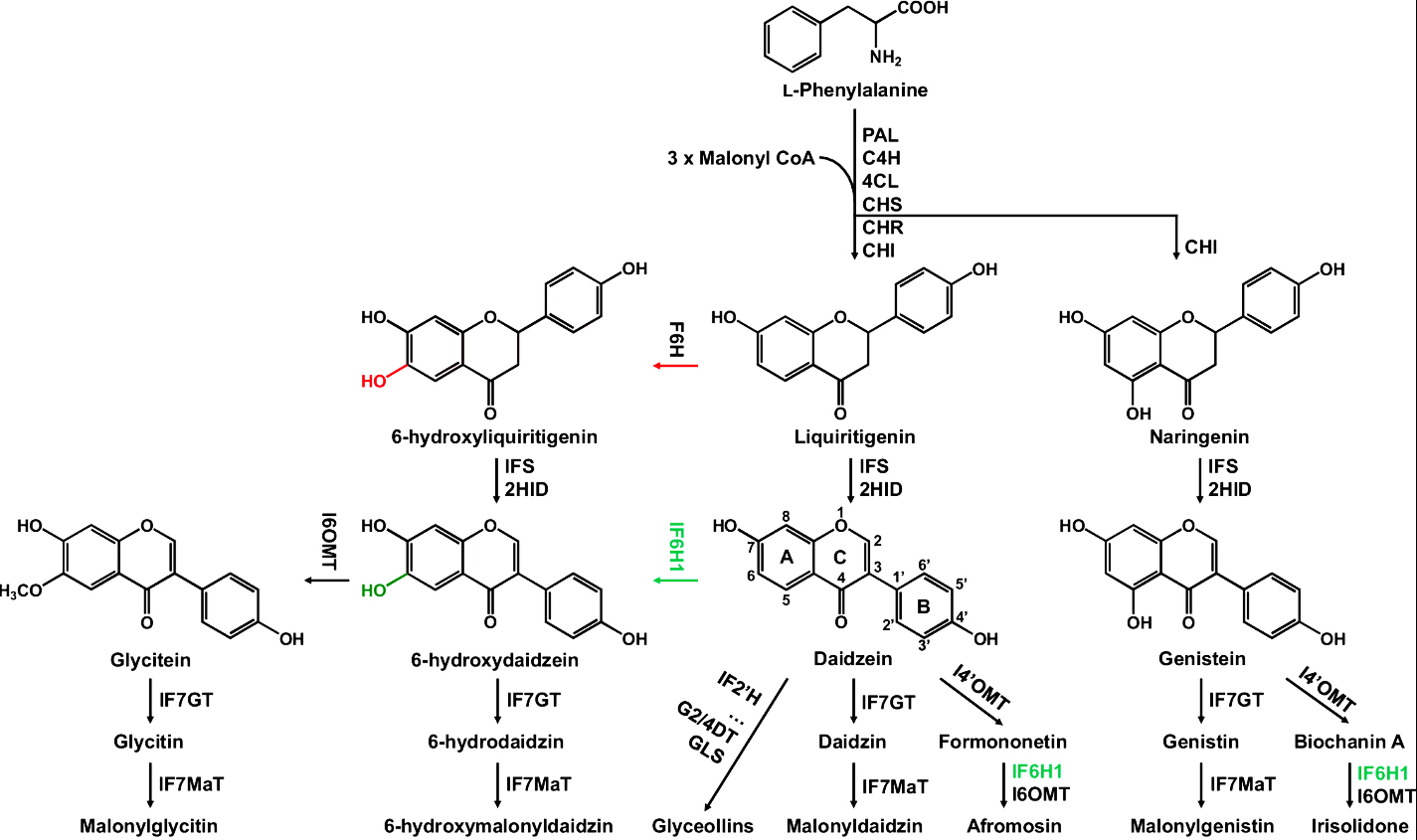
Figure 1: Isoflavonoid biosynthetic pathway in soybean. Red arrows denote the hypothesized route to glycitein from liquiritigenin, whereas green arrows denote the daidzein-derived route. Enzymatic steps catalyzed by IF6H1 (GmCYP76F17) and validated in this study are highlighted on the green branch. The isoflavone carbon-atom numbering is annotated on the daidzein structure. Abbreviations: C4H, cinnamate-4-hydroxylase; 4CL, 4-coumarate-CoA-ligase; CHS, chalcone synthase; CHI, chalcone isomerase; CHR, chalcone reductase; F6H, flavonoid 6-hydroxylase; G2/4DT, glycinol 2 or 4-dimethylallyl transferase; GLS, glyceollin synthase; IF2’H, isoflavone 2’-hydroxylase; IF6H1, isoflavone 6-hydroxylase 1; IFS, 2-hydroxyisoflavanone synthase; 2HID, 2-hydroxyisoflavanone dehydratase; I4’OMT, isoflavone 4’-O-methyltransferase; I6OMT, isoflavone 6-O-methyltransferase; IF7GT, UDP-glucose:isoflavone 7-O-glucosyltransferase; IF7MaT, malonyl-CoA:isoflavone 7-O-glucoside 6’’-O-malonyltransferase; PAL, phenylalanine ammonia-lyase.
Views: 239