


Potential yield and food provisioning gains from rebuilding the world’s coral reef fish stocks
Agricultural Science
Jessica Zamborain-Mason, Joshua E. Cinner, M. Aaron MacNeil, Maria Beger, David Booth, Sebastian C. A. Ferse, Christopher D. Golden, Nicholas A. J. Graham, Andrew S. Hoey, David Mouillot, and Sean R. Connolly
PNAS; December 16 2025; 122 (51) e2508805122; https://doi.org/10.1073/pnas.2508805122
Significance
Coral reef fisheries are a critical food source for people throughout the tropics. However, most reefs around the globe have fish biomass values below those enabling maximal sustainable production, risking food availability, income, and livelihoods. Rebuilding fish assemblages can increase sustainable food supplies and, if these are well distributed, directly contribute toward enhanced food security. We show that recovering fish stocks on coral reefs can significantly increase the number of sustainable fish servings produced per year and the number of people meeting fish intake recommendations, particularly for countries with high malnutrition. Our study highlights the sustainable food provisioning potential of recovering reef fisheries and quantifies how much recovery would be needed and the time such recovery would take.
Abstract
Many coral reefs have fish stocks that are depleted below the level at which sustainable production is maximized. Lower production means that millions of people are losing out on potential food, income, and livelihoods. Rebuilding these stocks to maximize sustainable production can contribute toward ending hunger and malnutrition but requires active and effective fisheries management. Yet, for fish stock recovery plans to be implemented, recovery benefits, targets, and timeframes need to be quantified. Here, using 1,211 individual reef sites and 23 jurisdictions identified globally as being below maximum sustainable production levels, we show that reefs have the potential to increase sustainable yields by nearly 50% if allowed to recover toward their maximum production levels. For individual jurisdictions, this recovery represents from 20,000 up to 162 million additional sustainable servings of reef fish per year in comparison to current sustainable production, meeting recommended seafood intake for up to 1.4 million additional people a year. However, such growth and food provisioning will require fish stocks to double their standing biomass (increase by a median of 32 t/km2). Recovery timeframes range from 6.4 y under the most stringent scenario (a moratorium) to 49.7 y under the maximum harvest scenario that results in recovery. We find that locations with the greatest potential for sustainable gains in yield are among those with the greatest food and micronutrient deficiencies, underscoring both the challenges and opportunities in recovering fish assemblages to achieve their maximum sustainable potential.
See https://www.pnas.org/doi/10.1073/pnas.2508805122
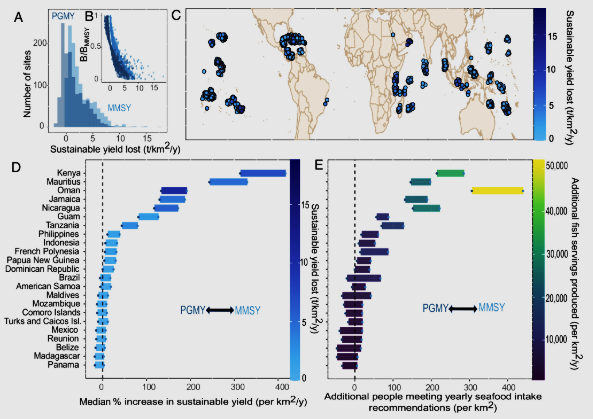
Figure 2: Per unit area sustainable yield lost from coral reef assemblages. (A) Posterior median sustainable yield loss for coral reef sites open to fishing classified as being below BMMSY. Colors represent losses based on MMSY (light blue) or PGMY (dark blue). Negative values in the PGMY distribution means those sites are already within PGMY values (i.e., between BPGMY,low and BMMSY). (B) Relationship between expected sustainable yield lost and site-specific biomass status (B/BMMSY). Points are posterior medians for each exploited site classified as below BMMSY. Different colors are the same sites but for MMSY and PGMY. (C) Map of sampled fished sites below BMMSY, color-coded by the median sustainable yield lost based on MMSY. Points are jittered to add clarity. (D) Median % increase in sustainable yields expected per jurisdiction if recovered to MMSY (upper limit of horizontal bar) or PGMY (lower limit of horizontal bar) in comparison to current estimated sustainable production. Only jurisdictions which have median estimated biomass values below BMMSY are included (biomass values are weighted optimistically assuming the proportion of marine protected areas in a jurisdiction are at unfished biomass values; Materials and Methods). Bars are colored by the median sustainable yield lost based on MMSY. (E) Additional people potentially meeting yearly seafood intake recommendations per square kilometer for each jurisdiction based on median values. Bars are colored by the potential additional number of fish servings produced per km2 if reef assemblages are recovered to MMSY. Note that in D and E if bars overlap the horizontal dashed line (~0% increase) it means that jurisdictions median biomass for exploited reefs is estimated to be within BPGMY,low and BMMSY (i.e., they are already estimated to be producing >80% of MMSY, so meeting 80% can result in negative numbers).
Views: 235