


Going wild in banana breeding enables Fusarium-resistant hybrids with improved fruit quality
Xin Liu, Ning Fu, Jia Li, Tian-Wen Xiao, Shaohua Zeng, Rong Jiang, Xin-Feng Wang, Hui-Ye Zhang, Lei Wei, Lu-Yun Lu, Zheng-Feng Wang, Hai-Fei Yan, Lin-Feng Li, Mathieu Rouard, Xue-Jun Ge, Wei-Ming Li, Hui-Run Huang
Nat Commun.; 2026 Mar 5. doi: 10.1038/s41467-026-70186-9. Online ahead of print.
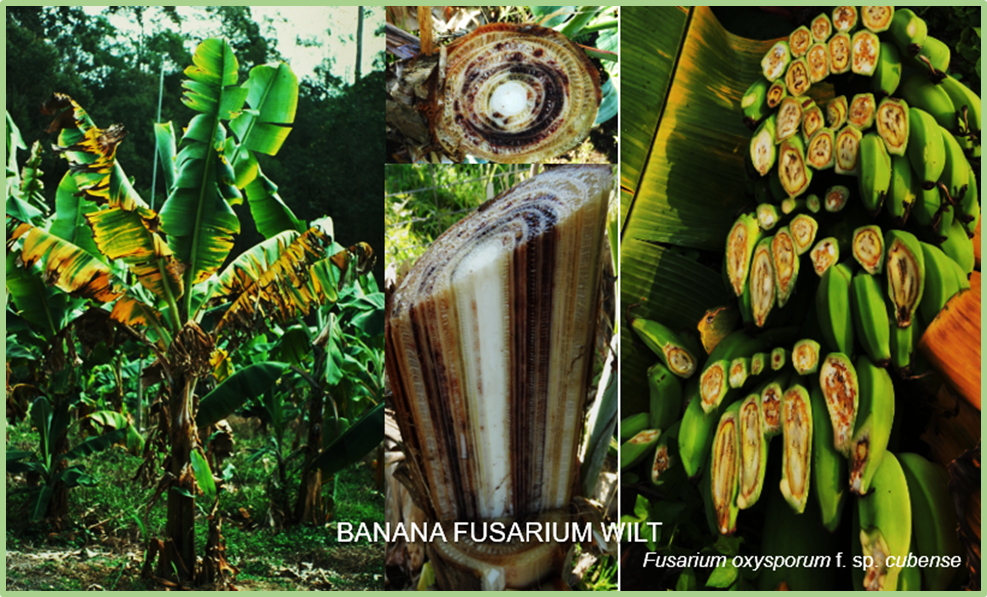
Figure: The symptom of banan Fusarium wilt
Abstract
Bananas (Musa spp.) are crucial for food security, but modern cultivars derived from few wild species and propagated vegetatively possess low genetic diversity, and weak disease resistance. Identifying new parental lines is therefore essential for banana breeding. Here we show that Musa cheesmanii exhibits high resistance to Fusarium oxysporum f. sp. cubense tropical race 4. We cross it with two Musa ABB cultivars popular in China, 'Yulin' and 'Jinyu'. The resulting hybrids exhibit enhanced disease resistance, high yield, desirable pulp taste, and extended shelf-life, underscoring the breeding value of this wild species. Additionally, a telomere-to-telomere, gap-free genome of M. cheesmanii is assembled, with multi-omics analyses offering insights into its diversification, black pseudo-stem coloration, and disease resistance. Overall, M. cheesmanii is a promising male parent for enhancing genetic diversity and improving banana cultivars.
Views: 131