


Identification and validation of novel and stable QTL for Gibberella stalk rot resistance in maize inbred KA105
Zhichao Zhang, Yao Yu, Dingfang Zhang, Ruiyu Zhang, Pizhou Wu, Zhe Wang, Jie Yang, Chuanyu Ma, Jiquan Xue & Qin Yang
Theoretical and Applied Genetics; January 13 2026; vol. 139; article 35
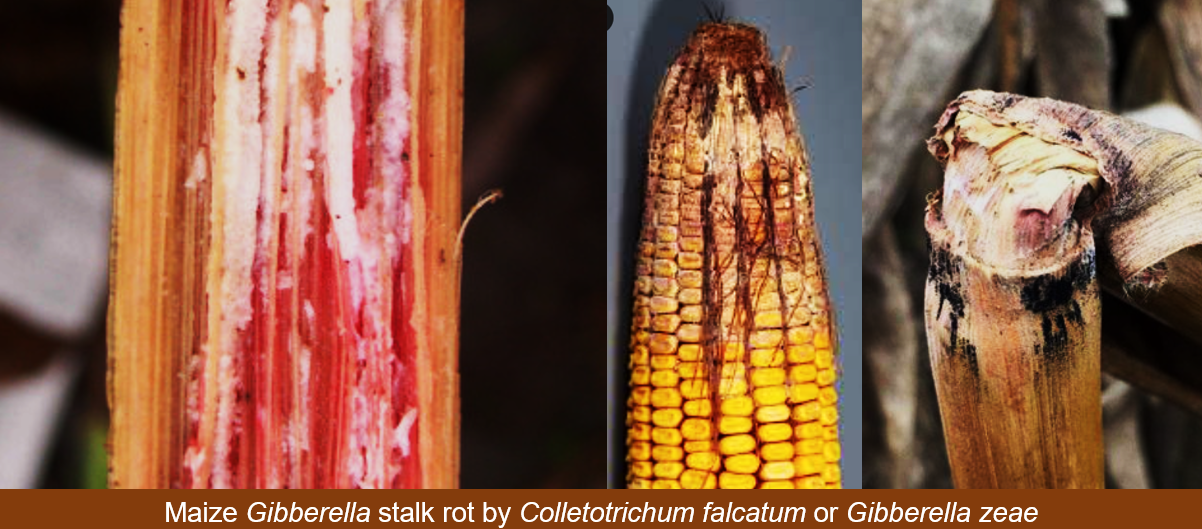
Key message
Four novel and stable disease resistance QTL associated with Gibberella stalk rot were identified and validated. A major QTL qGSR8.08 was fine-mapped to a 1.34 Mb region.
Abstract
Gibberella stalk rot (GSR) is a highly destructive fungal disease that threatens global maize production significantly. Although many quantitative trait loci (QTL) associated with maize stalk rot resistance have been identified, only a few have been validated and fine-mapped. KA105 is an elite maize inbred line widely utilized in arid and semi-arid areas in China, which shows high level of resistance to multiple diseases. Here, a recombinant inbred line (RIL) population derived from a cross between KA105 and KB204 was evaluated for GSR resistance in four environments and genotyped using 61,282 single-nucleotide polymorphism (SNP) markers. Twenty GSR QTL were identified: 11 are novel and stable QTL; 13 QTL contain favorable alleles from KA105. Phenotypic effects of four novel and stable QTL with relatively large effects, qGSR5.05, qGSR5.09, qGSR8.08, and qGSR10.06, were validated in field trials using near-isogenic lines (NILs) developed from heterogeneous inbred families (HIFs). KA105-derived alleles significantly reduced the mean disease severity index (DSI) by 15.20–52.02% compared to lines with the KB204 alleles at these loci. Pyramiding of multiple QTL, specifically qGSR5.05, qGSR5.09, qGSR8.08, and qGSR10.06, significantly enhanced stalk rot resistance and decreased yield losses in hybrids under field disease conditions. qGSR8.08 was further fine-mapped to a 1.34 Mb physical region, which conferred multiple disease resistance against Gibberella stalk rot, Gibberella ear rot, and Fusarium ear rot. This study provides valuable insights into the genetic basis of stalk rot resistance and demonstrates the potential of marker-assisted gene pyramiding to enhance maize disease resistance.
See https://link.springer.com/article/10.1007/s00122-025-05142-0
Views: 138