


Goldilocks zone of lignin: Two extremes of valve lignification lead to silique indehiscence in Brassicaceae
Justin B. Nichol, Logan A. Skori, Muhammad Jamshed, Neil Hickerson, Mendel Perkins, and Marcus A. Samuel
PNAS; December 22 2025; 122 (52) e2512939122; https://doi.org/10.1073/pnas.2512939122
Significance
The canola industry significantly contributes (C$43.7) billion to the Canadian economy. However, a major challenge persists with pod shattering at maturity, leading to an average annual seed loss of 3% (C$1.31 billion to the economy) due to spontaneous pod shatter. This loss can surge to 50% under harsh weather conditions. While shatter-tolerant canola varieties are available, their high seed costs often burden farmers. Our research offers a promising solution by exploiting canola pod lignification-a process of secondary cell wall deposition that reinforces the pod structure-to develop strong, shatter-tolerant canola lines. This innovation not only mitigates seed loss in canola but also holds potential for application in other agricultural crops, such as soybean and field peas.
Abstract
The spring-loaded spontaneous seed dispersal mechanism known as dehiscence, has been a critical plant feature for the successful colonization of land by angiosperms. Although advantageous for seed dispersal, spontaneous dehiscence is largely an unfavorable agronomic trait which historically was selected against during selective breeding of crops to increase seed retention. In canola (Brassica napus), a major global oil seed crop, spontaneous or harsh weather-induced fruit shattering at maturity could lead to yield losses from 3 to 50%. Here, we show an extraembryonic role for the ABA-responsive transcription factor, ABSCISIC ACID INSENSITIVE-3 (ABI3) in controlling seed dispersal through mediating lignification of the endocarp b (enb) layer and the lignified layer (LL) of the valves. The resistance created by these lignified layers is critical for valve opening at maturity as the tensile forces generated during silique drying converge on these fortified cell layers to trigger shatter. We further show that ABI3 functions independent of the patterning genes and functions through transcriptional regulation of NAC-domain transcription factors, NST1 and NST3, to mediate lignin biosynthesis. Our results show that both excessive and complete absence of lignification could prevent the tensile drying forces from breaking open the pod, leading to fruit indehiscence. As a proof-of-concept, we show that BnABI3 overexpression in canola results in highly lignified, robust siliques that are shatter tolerant. Besides uncovering an extraembryonic role for ABI3, this study has identified spatial distribution and abundance of lignin in the silique valve tissue as the key determinants for silique dehiscence.
See https://www.pnas.org/doi/10.1073/pnas.2512939122
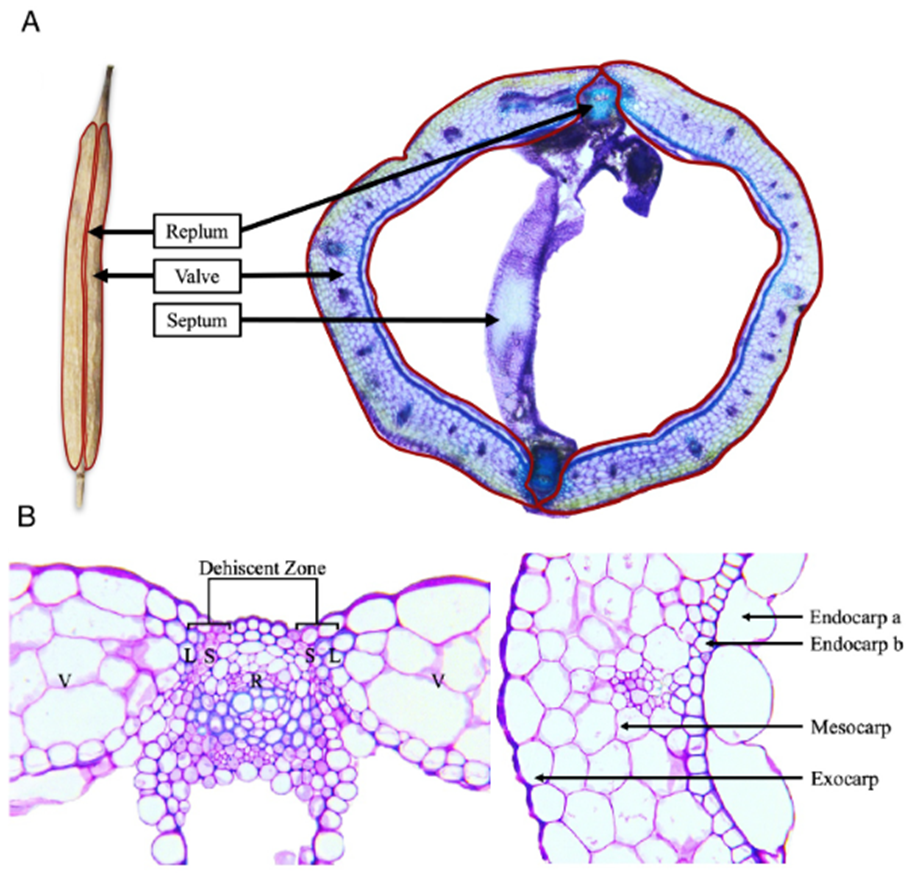
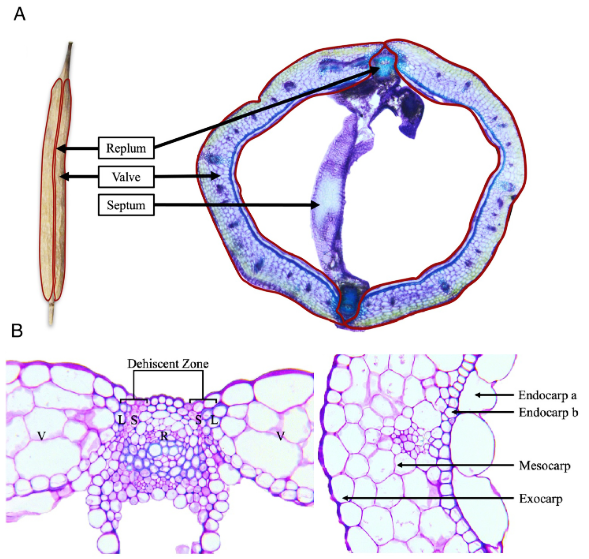
Figure 1: Overview of canola and A. thaliana cross-sectional silique anatomy. (A) The external features (replum, valve) of the canola silique. The highlighted region in red on the silique represents the outline of the two valves which fuse with the central replum to form an enclosed structure. Cross-section of the canola silique highlighting the organization of replum, valve, and septum tissues is shown on the Right. The highlighted region of the canola cross-section in red represents the boundary of the valve tissue. (B) Cross-section of Arabidopsis silique focused on anatomical features of the dehiscence zone. V- valve, L- lignified layer, S- separation layer (nonlignified layer), R- replum.
Views: 179