


Glycosylation of glyphosate drives residue reduction and herbicide tolerance in rice
Fulai Yang, Yuehua Wang, Wentao Zhou, Chengfeng Xue, Fengshou Dong, Yongquan Zheng, Meng Zhang, Li Chen, Jun Zhang, Xinglu Pan and Ruifeng Yao
PNAS; February 23, 2026; 123 (9) e2516099123
Significance
Weeds pose a major threat to rice yield losses, driving the urgent need for judicious glyphosate application and glyphosate-tolerant rice varieties in modern agriculture. Transgenic lines with glyphosate tolerance are available, but developing nontransgenic resistant germplasm remains valuable for ensuring food and biosafety. This study identifies the rice variety Kitaake as a natural source of glyphosate tolerance. Through transcriptome analysis and glyphosate-metabolism pathway identification, we demonstrate that Kitaake’s tolerance stems from glyphosate glycosylation catalyzed by the UDP-glycosyltransferase GRGT1. This mechanism was validated by overexpressing and complementing GRGT1 in glyphosate-sensitive rice accessions. Our findings elucidate a natural tolerance mechanism and provide a vital genetic resource for quickly developing low-residue crops, thereby contributing to sustainable weed management and agriculture.
Abstract
Glyphosate is the most widely used herbicide globally, especially due to the extensive cultivation of genetically modified glyphosate-resistant crops. However, its intensive application has raised public concerns about the risks to food safety and human health. Identifying enzymes capable of metabolizing glyphosate in plants represents an ideal strategy for addressing this issue, but few are known. Here, we identified the rice variety Kitaake with natural tolerance to glyphosate and demonstrated that this tolerance is driven by glyphosate glycosylation metabolism. Seven up-regulated UDP-dependent glycosyltransferase (UGT) genes associated with glyphosate tolerance were identified in Kitaake. Molecular-docking analysis indicated that these UGT proteins have moderate binding affinity for glyphosate. Among these, a deletion of an adenine at position –803 in the promoter region of GLYPHOSATE RESPONSIVE GLYCOSYLTRANSFERASE 1 (GRGT1) enhances its expression in Kitaake. GRGT1 localizes to the endoplasmic reticulum and catalyzes glyphosate glycosylation both in vivo and in vitro. Rice lines complemented with GRGT1–GFP rescue the inability of grgt1 knockout mutants to produce glycosylated glyphosate derivatives. Overexpression of GRGT1 in the susceptible Nipponbare cultivar confers glyphosate tolerance by up-regulating glyphosate metabolism to produce glycosylated glyphosate derivatives M329, M331, and M345. This provides a strategy for developing herbicide-tolerant crops, but also offers a potential approach to consequently reduce glyphosate residues in crops.
See: https://www.pnas.org/doi/10.1073/pnas.2516099123
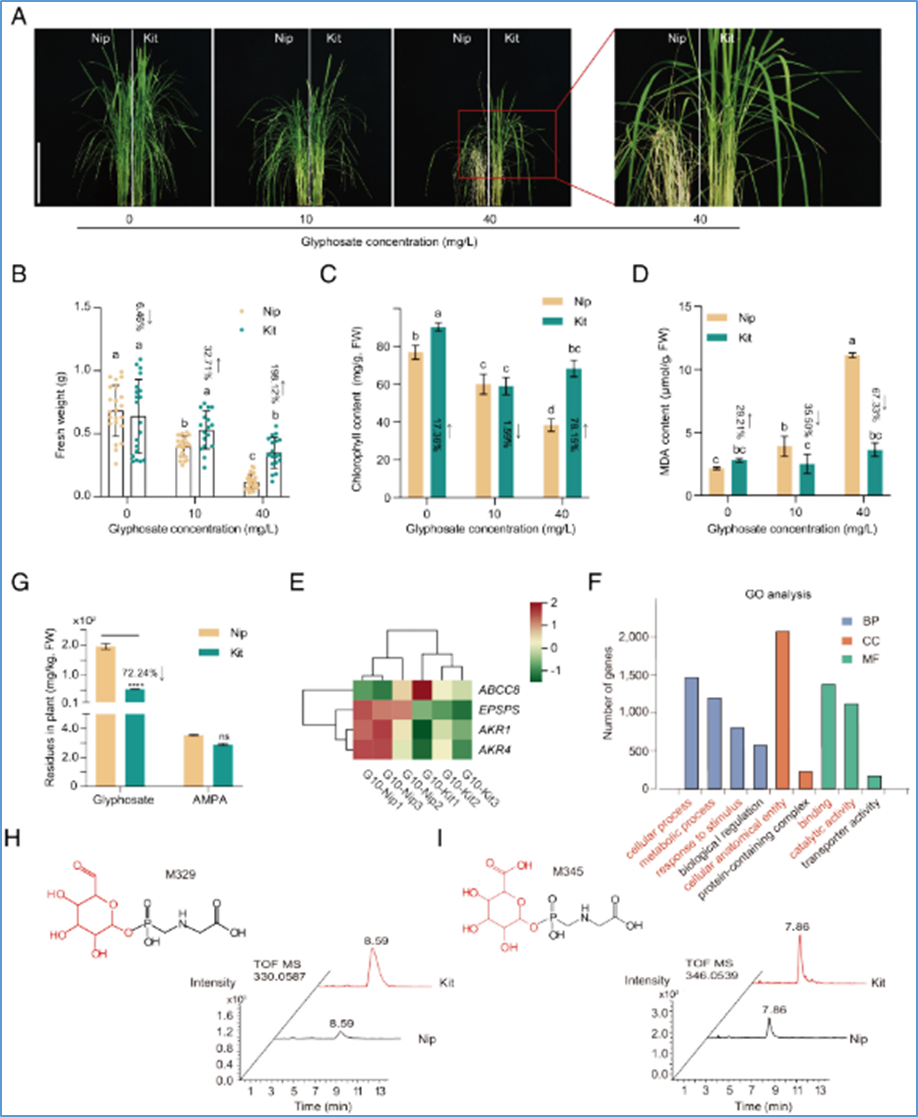
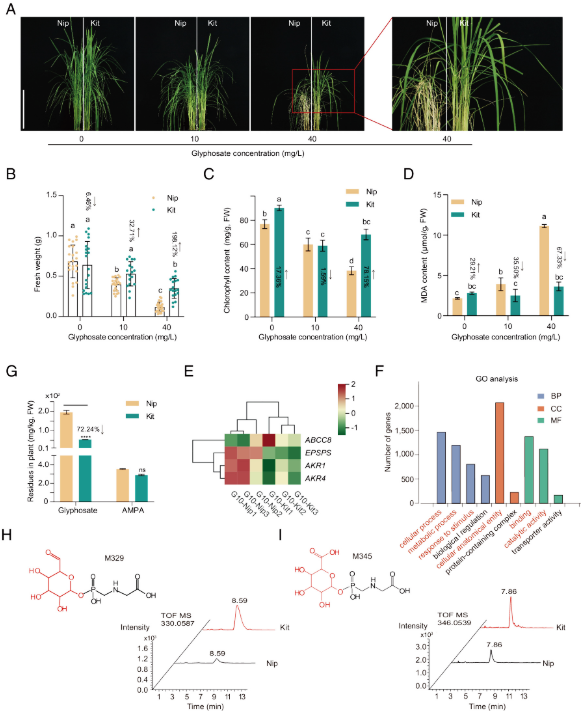 Figure 1
Identification and characterization of a glyphosate-tolerant rice variety Kitaake. (A) Shoots of hydroponically grown Nipponbare and Kitaake plants after 7 d of glyphosate treatment. (Scale bar, 10 cm.) (B) Fresh weight per plant for plants grown as in (A). (C) Total chlorophyll content for plants grown as in (A). (D) MDA content for plants grown as in (A). (E) Heatmap of transcript levels of common, known glyphosate resistance genes in Nipponbare and Kitaake exposed to 10 mg/L glyphosate for 3 d. G10: 10 mg/L glyphosate. (F) Gene-ontology (GO) analysis of 3,529 DEGs found in the G10-Kit versus G10-Nip cluster. BP: Biological Process; CC: Cell Component; MF: Molecular Function. (G) Concentration of glyphosate and AMPA residues in stem leaves after 7 d of 40 mg/L glyphosate treatment. (H and I) LC-HR-TOF MS chromatogram and chemical structure of glycosylated glyphosate derivatives M329 (H), M345 (I) after 7 d of 40 mg/L glyphosate treatment. Each experiment was performed in triplicate, and values are presented as mean ± SD; n ≥ 17 for (B). n ≥ 3 for (C–G), n ≥ 2 for (H–I); two-way ANOVA was performed for (B–E and G).
Views: 483