


(E)-2-Hexenal Combats Rice Sheath Blight Through Direct Pathogen Inhibition and Host Defense Reprogramming
Wenyan Fan, Wenjuan Wang, Xinyan Liang, Liting Feng, Xinyi Lv, Jitong Li, Yiping Wang, Jinglan Liu
Plants (Basel); 2026 May 21; 15(10):1581. doi: 10.3390/plants15101581.
Abstract
Volatile organic compounds (VOCs) have garnered substantial research interest in recent years due to their biodegradability, low toxicity, and potent antimicrobial properties against various plant pathogens. As a typical herbivore-induced plant volatile (HIPV) elicited by Nilaparvata lugens (Brown planthopper, BPH), (E)-2-hexenal has been identified as a promising natural antimicrobial agent. In this study, we investigated the protective potential of (E)-2-hexenal against Rhizoctonia solani (R. solani) in rice, focusing on both its direct antifungal activity and host-mediated defense mechanisms. In vitro antifungal assays demonstrated that treatment with 100 μL/mL (E)-2-hexenal resulted in a 91.07% inhibition of R. solani mycelial growth after 48 h. Scanning electron microscopy (SEM) observation and chitinase activity analysis revealed that (E)-2-hexenal suppressed fungal growth by disrupting the structural integrity of the pathogen cell wall. Furthermore, 100 μL/mL (E)-2-hexenal effectively conferred protection to detached rice leaves. Whole-plant inoculation assays confirmed that (E)-2-hexenal pretreatment significantly alleviated disease symptoms and triggered systemic resistance in rice plants. Physiological and biochemical analyses showed that (E)-2-hexenal treatment enhanced the activities of defense-related enzymes, elevated hydrogen peroxide (H2O2) levels, and promoted the accumulation of defensive metabolites in rice leaves. HPLC-MS quantification further revealed significant increases in the endogenous levels of jasmonic acid (JA) and salicylic acid (SA). Transcriptomic KEGG pathway enrichment analysis indicated that differentially expressed genes (DEGs) were mainly involved in alpha-linolenic acid metabolism, diterpenoid biosynthesis, phenylpropanoid biosynthesis, plant-pathogen interaction, and plant hormone signal transduction. Collectively, these results suggest that (E)-2-hexenal enhances rice resistance to sheath blight disease via a dual-action mechanism: direct inhibition of fungal development and activation of host immune responses. Our findings highlight the potential application of (E)-2-hexenal and other VOCs in developing eco-friendly strategies for sustainable rice disease management.
See https://pubmed.ncbi.nlm.nih.gov/42197714/
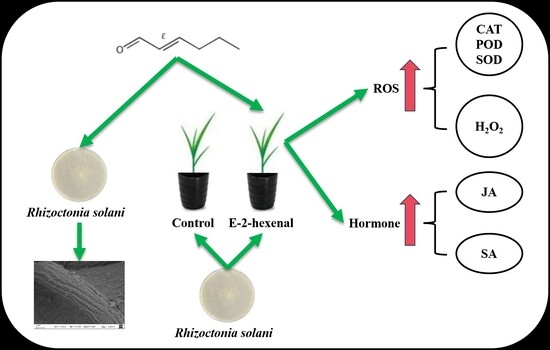
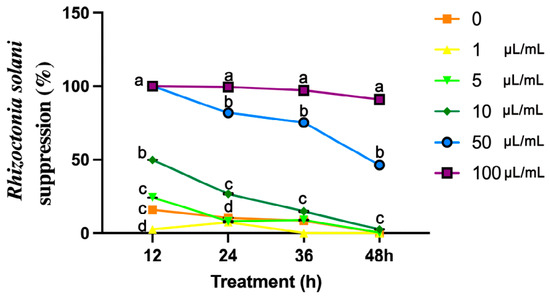
Figure 2. Suppression of R. solani by (E)-2-hexenal. The horizontal axis represents the treatment concentration. The suppression rate of (E)-2-hexenal on R. solani was quantified as the reduction in mycelial biomass compared to the control group. Data points represent means ± SE (N = 8). Different lowercase letters (a, b, c, d) indicate significant differences based on one-way ANOVA (p < 0.05).
Views: 9