


Climate change drives a decline in global grazing systems
Chaohui Li, Maximilian Kotz, Prajal Pradhan, Xudong Wu, Yuanchao Hu, Zhi Li, and Guoqian Chen
PNAS; February 9, 2026; 123 (7) e2534015123; https://doi.org/10.1073/pnas.2534015123
Significance
Grazing systems form critical livelihood bases for hundreds of millions of people across diverse ecological and socioeconomic contexts, yet we lack a global understanding of their sensitivity to climate change. Applying a “safe climatic space” framework, we project a 36 to 50% contraction in suitable grazing areas by 2100 due to future climate change. We show the loss of safe climatic space for grazing overlaps significantly with regions already suffering from severe poverty, hunger, and political fragility. We estimate this could displace the livelihoods of over 100 million pastoralist and 1.4 billion livestock. These findings highlight how climate change will compound existing inequalities, threatening to destabilize the world’s most extensive food production system and the communities that depend on it.
Abstract
Grazing systems represent the most extensive production systems in the world and are highly sensitive to climate change. However, their global-scale sensitivity and vulnerability to climate impacts remain poorly understood. Here, we apply the safe climatic space framework to assess how changes in core climatic drivers of grazing suitability, including temperature, precipitation, humidity, and wind speed, will reshape global grassland-based grazing systems. Our analysis projects a net decline of 36 to 50% of areas in climate suitability for grazing by 2100, accompanied by inter- and intracontinental shift of grazing suitability. These changes are expected to negatively affect 110 to 140 million pastoralists and 1.4 to 1.6 billion livestock, with particularly severe impacts in Africa. We further show that 51 to 81% of these impacted populations reside in countries with low income, serious hunger, severe gender inequality, and high political fragility. Our study implies that future climate change will threaten grazing suitability across large portions of Earth, endangering the livelihoods of numerous communities and potentially triggering widespread socioeconomic consequences.
See https://www.pnas.org/doi/10.1073/pnas.2534015123
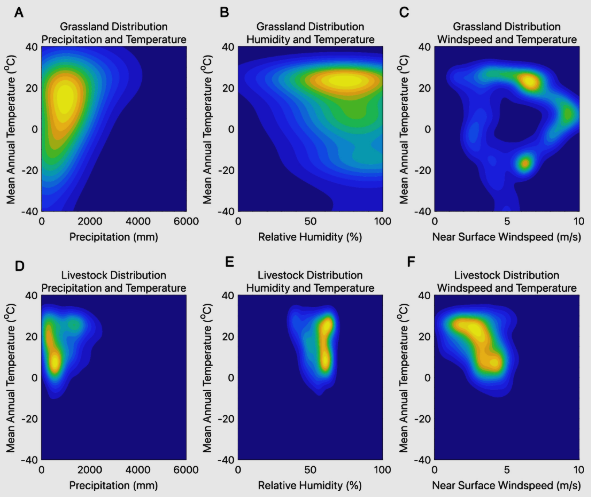
Figure 1: The distribution of the safe climatic space for grazing. (A–F) shows the distribution of grassland (A–C) and grazing activities (D–F) across climate conditions. Present (D–F) grazing activities are clustered in a subset of the world’s grasslands (A–C), enveloped by climate conditions of mean annual temperature, precipitation, humidity, and wind speed. The highlighted yellow regions indicate a high density of livestock/pasture pixel agglomeration and identify regions where grazing is densely distributed, which is a signal of high grazing suitability.
Views: 262