


News & Events
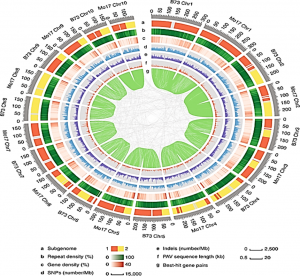
Reductions of genotyping marker density have been extensively evaluated as potential strategies to reduce the genotyping costs of genomic selection (GS). Low-density marker panels are appealing in GS because they entail lower multicollinearity and computing time and allow more individuals to be genotyped for the same cost. However, statistical models used in GS are usually evaluated with empirical data, using "static" training sets and populations.
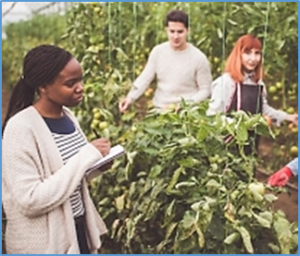
FAO News: In January 2022 FAO and IAAS (International Association of Students in Agricultural and Related Sciences), in collaboration with YPARD (Young Professionals for Agricultural Development) launched the Youth for Green and Climate-Resilient Agriculture Programme (YCRA) to support and promote youth-led projects. The initiative aims to contibute to capacity development, to give visibility to youth active in the agriculture sectors and to support the transfer of skills between generations.
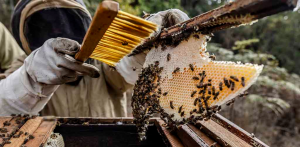
The Food and Agriculture Organization of the United Nations (FAO) has made huge strides in pushing for agrifood systems transformation towards more efficiency, inclusivity, resilience, and sustainability in the face of the climate crisis, through coherent and ambitious actions that also tackle global environmental degradation and biodiversity loss. FAO’s work on climate change is guided by the new FAO Strategy for Climate Change 2022-2031, which aims to support Members to transform to sustainable, climate-resilient and low-emission agrifood systems while striving to achieve the Sustainable Development Goals (SDGs).
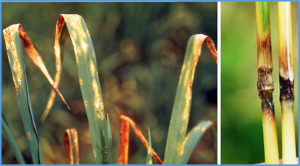
Pattern-triggered immunity (PTI) and effector-triggered immunity (ETI) in plants enable them to respond to pathogens by activating the production of defence metabolites that orchestrate immune responses1-4. How the production of defence metabolites is promoted by immune receptors and coordinated with broad-spectrum resistance remains elusive. Here we identify the deubiquitinase PICI1 as an immunity hub for PTI and ETI in rice (Oryza sativa).
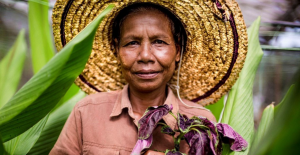
First up, we’d like to introduce you to IFAD’s new President, Alvaro Lario, who tells us about his plans for the agency. Then, the Associate Vice-President of the External Relations and Governance Department, Satu Santala, gives us an overview of the upcoming funding cycle and an insight into the Global Donor Platform for Rural Development. We revisit conversations we conducted earlier this year with donors to hear about the issues that matter the most to them.
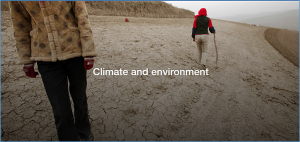
Smallholder farmers and poor rural people bear the brunt of climate change and the degradation of natural resources. Extreme weather events, such as droughts, storms and floods, are putting pressure on the ecosystems that farmers depend on, as are gradual processes such as rising sea levels and melting glaciers. Crop failures and livestock deaths are causing economic losses and undermining the food security of rural people with ever-greater frequency, especially in parts of sub-Saharan Africa.
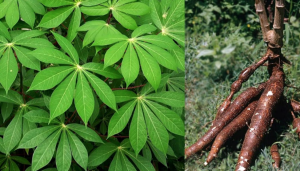
Cassava (Manihot esculenta Crantz) is the sixth most important food crop and consumed by 800 million people worldwide. In Africa, cassava is the second most important food crop after maize and Africa is the worlds' largest producer. Though cassava is not one of the main commodity crops in South Africa, it is becoming a popular crop among farming communities in frost-free areas, due to its climate-resilient nature.
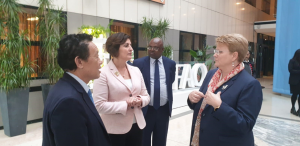
The International Crops Research Institute for the Semi-Arid Tropics (ICRISAT) moderated the technical segment of the opening ceremony of the International Year of Millets (IYM2023) at the Food and Agriculture Organization (FAO) in Rome on 6 December 2022. ICRISAT had a pivotal role in supporting the Government of India’s proposal in the FAO Council to celebrate the International Year of Millets, working with governments in its host countries in Africa to gather support letters.
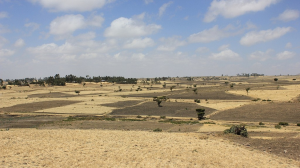
November 2022 was a watershed moment when the world population crossed 8 billion. In 2011 the world population was 7 billion and by 2050 it is expected to touch 9.8 billion. The world’s population more than tripled between 1950 and 2020. More than half of the projected increase in the global population up to 2050 will be concentrated in eight countries: the Democratic Republic of the Congo, Egypt, Ethiopia, India, Nigeria, Pakistan, the Philippines and Tanzania. Countries of sub-Saharan Africa are expected to contribute more than half of the increase anticipated through 2050.
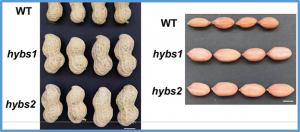
Seed size is the major yield component and a key target trait that is selected during peanut breeding. However, the mechanisms that regulate peanut seed size are unknown. Two peanut mutants with bigger seed size were isolated in this study by 60Co treatment of a common peanut landrace, Huayu 22, and were designated as the "big seed" mutant lines (hybs). The length and weight of the seed in hybs were about 118% and 170% of those in wild-type (WT), respectively. We adopted a multi-omics approach to identify the genomic locus underlying the hybs mutants.
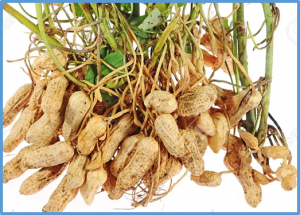
Peanut (Arachis hypogaea L.), an allotetraploid legume of the Fabaceae family, is able to thrive in tropical and subtropical regions and is considered as a promising oil seed crop worldwide. Increasing the content of oleic acid has become one of the major goals in peanut breeding because of health benefits such as reduced blood cholesterol level, antioxidant properties and industrial benefits such as longer shelf life. Genomic sequencing of peanut has provided evidence of homeologous AhFAD2A and AhFAD2B genes encoding Fatty Acid Desaturase2 (FAD2), which are responsible for catalyzing the conversion of monounsaturated oleic acid into polyunsaturated linoleic acid.
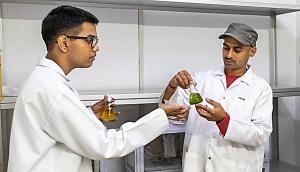
Sarvesh Prabhu, a 17-year-old research intern at the International Crops Research Institute for the Semi-Arid Tropics (ICRISAT), represented India at the International Science and Engineering Fair in Atlanta, USA and won the third prize and US $1000 in the biochemistry category for developing a cost-effective bio-insecticide from the leaves of bullock’s heart (Annona reticulata) popularly known as ramphal.