


News & Events
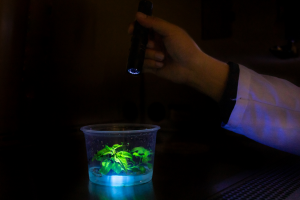
Scientists from the Oak Ridge National Laboratory (ORNL) successfully inserted multiple genes into plants using only a single step. The new method could revolutionize the way researchers around the world conduct genetic transformation. The technique, known as gene stacking, replaces the laborious way of individually inserting genes into a targeted plant's DNA. Each transformation also requires its own confirmation test to determine if the gene is in the right spot and orientation to exhibit the intended desired trait.
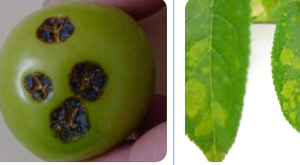
Plum (Prunus salicina L.) is a traditional fruit in Southern China and is ubiquitous throughout the world. In August 2021, leaves of plum trees showed water-soaking spots and light yellow-green halos with incidence exceeding 50% in Babu district in Hezhou, Guangxi (N23°49'-24°48', E111°12'-112°03'). To isolate the causal agent, three diseased leaves collected from three different trees growing in different orchards were cut into 5 mm × 5 mm pieces, disinfected with 75% ethanol for 10 sec, 2% sodium hypochlorite for 1 min and rinsed three times in sterile water.

The Philippine Department of Agriculture (DA) has pledged support in co-organizing the largest gathering of the stakeholders of rice-based food systems worldwide in the Philippines this coming October with the International Rice Research Institute (IRRI). “Rice is one of the priority areas of the Philippine government to achieve food self-sufficiency and improve the lives of Filipino farmers. At IRC 2023, we can learn about recent advancements in genetic, digital, and nature-based solutions, offering valuable insights to address the various challenges faced by the rice industry in the Philippines,”
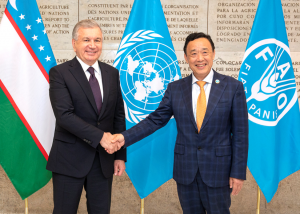
The FAO Director-General, QU Dongyu, and the President of the Republic of Uzbekistan, H.E. Shavkat Mirziyoyev, met to discuss ways to boost collaboration between FAO and Uzbekistan. President Mirziyoyev expressed appreciation for the Director-General’s personal leadership in reforming FAO to make the Organization more agile and efficient in responding to ongoing challenges.
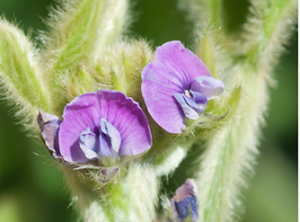
Recombination allows for the exchange of genetic material between two parents, which plant breeders exploit to make improved cultivars. This recombination is not distributed evenly across the chromosome. Recombination mostly occurs in euchromatic regions of the genome and even then, recombination is focused into clusters of crossovers termed recombination hotspots.
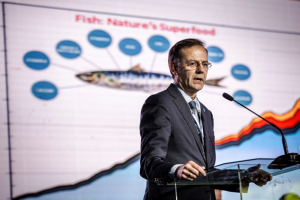
The ocean is key to global food security, the livelihoods of over 600 million people, and essential to transforming agrifood systems, according to Manuel Barange, Director of the Fisheries and Aquaculture Division at the Food and Agriculture Organization of the United Nations (FAO). Barange, a top marine scientist, is currently bringing all his expertise, among other initiatives, to help countries lead a Blue Transformation to sustainably expand aquatic food systems to benefit both people and planet, leaving no one behind.

Sierra Leone, FAO and Viet Nam today signed a South-South and Triangular Cooperation (SSTC) agreement aimed at developing the rice sector in the African country. The new project has an estimated budget of $5 million to be implemented through a Unilateral Trust Fund (UTF) from Sierra Leone. The tripartite agreement was signed by His Excellency Abu Bakarr Karim, Minister for Agriculture, Forestry and Food Security of Sierra Leone, and by Saeed Abubakar Bancie, FAO Representative in Sierra Leone.
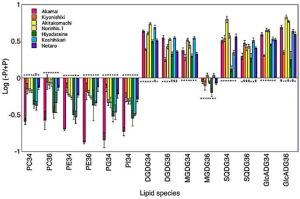
Plants have evolved various mechanisms for low P tolerance, one of which is changing their membrane lipid composition by remodeling phospholipids with non-phospholipids. The objective of this study was to investigate the remodeling of membrane lipids among rice cultivars under P deficiency. Rice (Oryza sativa L.) cultivars (Akamai, Kiyonishiki, Akitakomachi, Norin No. 1, Hiyadateine, Koshihikari, and Netaro) were grown in 0 (-P) and 8 (+P) mg P L-1 solution cultures.
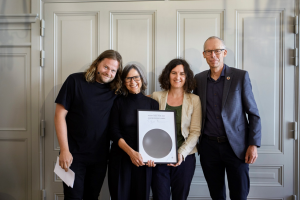
“The Agrobiodiversity Index has done something that has never been tried before”, said the announcement of our researchers winning the Food Planet Prize, one of the most important environmental awards in the world. The news was broken today, June 9th, in Stockholm, Sweden, by the Curt Bergfors Foundation after a year-long process of selecting and shortlisting more than 1,000 nominations.

Researchers from the University of California Los Angeles reviewed the reasons for consumer resistance against cultured meat. Based on their findings, they proposed communication measures to promote education about its production and benefits, which can improve acceptance among consumers.
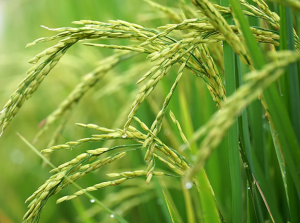
The expression of STK was rapidly induced by ABA. STK was highest expressed in the stem at the heading stage. STK was localized at the plasma membrane. Overexpression of STK in rice increased tolerance to salt stress and oxidative stress by increasing ROS scavenging ability and ABA sensitivity. In contrast, CRISPR/Cas9-mediated knockout of STK increased the sensitivity of rice to salt stress and oxidative stress.
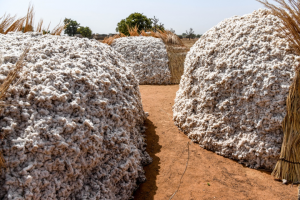
Michigan State University researchers and partners reviewed the sustainable access to quality seeds of genetically engineered Bt cotton in Eastern Africa and recommended improved public-private partnerships. Their review article is published in the journal GM Crops and Food. Genetically engineered Bt cotton varieties contribute solutions to challenges in crop losses and productivity. In Eastern Africa, Bt cotton has been commercially approved in Sudan (2012)