


News & Events
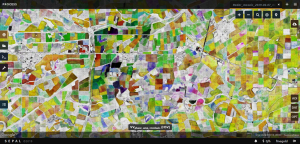
Many of the new satellites currently in Earth’s orbit are equipped to provide revolutionary tools and data to improve global food security and strengthen agrifood systems. A new report from the Food and Agriculture Organization of the United Nations (FAO) and the United Nations Office for Outer Space Affairs (UNOOSA) aims to inform and guide an array of experts and policy makers on the various intersections of space technology and farming, forestry and land-use management as well as climate and environmental trends.
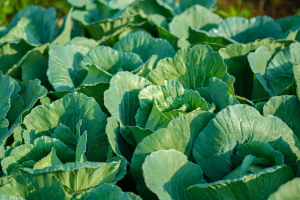
A study published in the Journal of Integrative Plant Biology generated novel BPM6 and DMR6 mutants of wild cabbage (Brassica oleracea) with broad-spectrum disease resistance using the CRISPR-Cas9 system. The findings of the study highlight the potential of gene editing as a powerful tool for disease resistance breeding to improve crop resilience and ensure sustainable agricultural production.
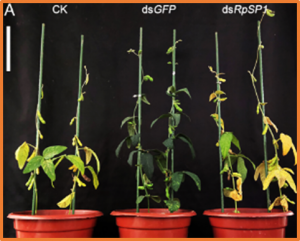
The stinkbug Riptortus pedestris, notorious for inducing soybean staygreen-like syndrome, employs a range of salivary proteins to manipulate the host plant for its benefit. Here, we show that RpSP1, a salivary protein specific to Pentatomomorpha, triggers plant defense responses in multiple plant species. RpSP1 interacts with and stabilizes a HSP40 family protein GmSPIP1 and is dependent on GmSPIP1 to induce cell death.
Researchers from Tennessee State University and partners explored the efficacy of carbon dots, which are synthesized rapidly and cost-effectively from citric acid monohydrate and β-alanine using a microwave-assisted method, as carriers for plasmid DNA delivery into plant tissues. The findings are published in Frontiers in Chemistry.
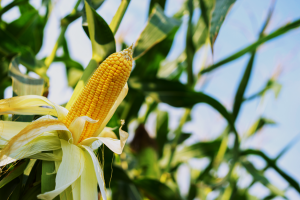
In maize, salt stress significantly hinders growth and yield. Abscisic acid-, stress-, and ripening-induced (ASR) proteins are known to be crucial for plant stress responses. In a collaborative study conducted by researchers from China, Australia, and the Netherlands, ZmASR6, a salt-induced ASR gene in maize was examined. The researchers observed that ZmASR6 expression was strongly induced by salt stress within 24 hours.
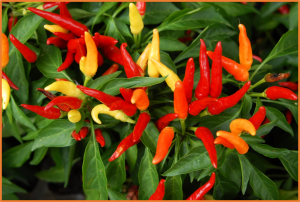
The effects of salt stress on plant development and progression are substantial. Ethylene response factor transcription factors (TFs) play a crucial role in responses to salt stress. Their functions in the salt response, particularly in pepper, are still mostly unknown. This study revealed the function of CaERF2 in salt tolerance of pepper plants. CaERF2 expression was dramatically increased in pepper plants following salt stress treatment
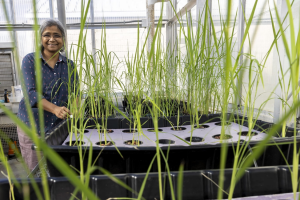
As nighttime temperatures increase in rice-growing regions like Arkansas, Vibha Srivastava, professor of plant biotechnology in the crop, soil and environmental sciences department, points to gene editing to help develop varieties with higher temperature tolerance. Photo Source: University of Arkansas System Division of Agriculture
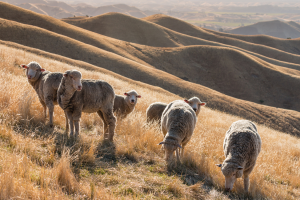
A study published in Nature demonstrates the generation and propagation of gene-edited fine wool sheep with high fecundity through CRISPR-Cas9. This research introduces a novel approach by integrating gene editing with traditional breeding methods to create gene-targeted founders and grow a population with desirable traits.
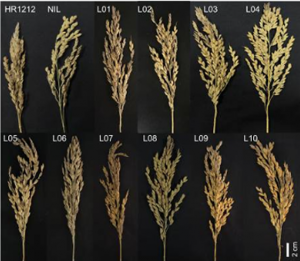
Huruan1212 (HR1212) is well-regarded for its superior eating and cooking quality in the lower reaches of the Yangtze River in China. Still, its high susceptibility to rice panicle blast and lack of fragrance have limited its further spread and utilization. Pigm and Pi-ta are two dominant genes known for their stable broad-spectrum resistance against rice blast fungus Magnaporthe oryzae, while badh2 is the crucial gene that regulates rice aroma. In this study, we utilized a molecular marker-assisted selection backcrossing strategy to introduce Pigm, Pi-ta, and badh2 into introgressed lines employing re-sequencing for precise genetic background selection.

South Africa is reaffirming its commitment to global efforts to conserve and sustainably use plant genetic resources essential for food security and agricultural biodiversity. The National Plant Genetic Resources Centre (NPGRC) of South Africa has approximately 6,300 accessions of different crops and is responsible for the ex situ conservation of more than 700 species, including beans, cowpeas, Bambara groundnuts, maize and sorghum.
A study conducted by researchers from the Ministry of Ecology and Environment, Nanjing China showed that the cultivation of genetically modified (GM) soybean did not alter the overall structure of rhizosphere soil microbial communities. High-throughput sequencing revealed that, while GM soybeans slightly altered bacterial and fungal composition, these changes were insignificant across all growth stages.
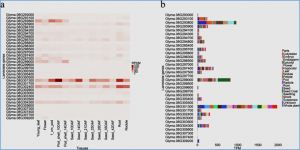
Sucrose in soybean [Glycine max (L.) Merr.] contribute to animal feed efficiency and natural sweetness of soy products. Thus, identifying novel genetic resources, such as quantitative trait loci (QTL), associated with sucrose content in soybean is essential for enhancing seed values. In this study, two recombinant inbred line populations derived from the same high sucrose donor parent, PI 506593, were used to identify significant QTLs. A total of 11 sucrose-related regions on chromosomes (Chrs.) 4, 5, 6, 8, 10, and 13 were identified using QTL analysis.