


News & Events
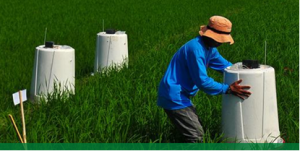
A recent study by researchers at the International Center for Tropical Agriculture (CIAT), the International Rice Research Institute (IRRI) and the Institute of Policy and Strategy for Agriculture and Rural Development (IPSARD) in Vietnam suggests that better practices for coffee, rice, maize, and livestock production, can help Vietnam increase its Paris Agreement commitments.
Crop yield improvement is necessary to keep pace with increasing demand for food. Due to climatic variability, the incidence of drought stress at crop growth stages is becoming a major hindering factor to yield improvement. New techniques are required to increase drought tolerancealong with improved yield. Genetic modification for increasing drought tolerance is highly desirable, and genetic engineering for droughttolerance requires the expression of certain stress-related genes. Genes have been identified which confer drought tolerance and improve plant growth and survival in transgenic wheat.
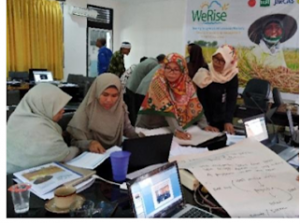
WeRise is an Information and Communications Technologies for Development (ICT4D) tool that integrates seasonal climate predictions with crop growth and nutrient management models to provide recommendations on optimum planting times, suitable rice varieties to use, and the timing of fertilizer application for rainfed rice-growing areas under current and future climate conditions. As farmers continue to grapple with the effects of climate change
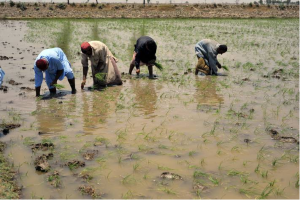
The Board of the Green Climate Fund (GCF) today approved an FAO project designed to transform Pakistan's Indus River Basin by improving agriculture and water management to make this vital food-producing region more resilient to climate change.The Green Climate Fund (GCF) has provided FAO with a grant of nearly $35 million for this work, while the provincial governments of Punjab and Sindh have committed an additional $12.7 million in co-financing to be managed by FAO.
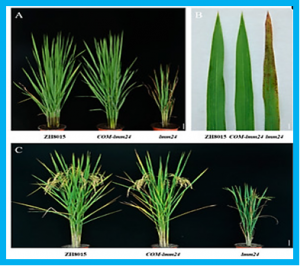
Lesion mimic mutants are excellent models for research on molecular mechanisms of cell death and defense responses in rice. We identified a new rice lesion mimic mutant lmm24 from a mutant pool of indica rice cultivar "ZhongHui8015". The LMM24 gene was identified by MutMap, and LMM24 was confirmed as a receptor-like cytoplasmic kinase 109 by amino acid sequence analysis. The lmm24 mutant displayed dark brown lesions in leaves and growth retardation that were not observed in wild-type ZH8015.

In August 2017, worrying signs began to emerge from Sudan's Kassala State that communities there were facing trouble: a dry spell had extended far beyond the norm and large numbers of livestock were being driven off traditional grazing routes by their owners in a desperate search for water and something green to feed on. Another alarm bell was triggered when the price of sorghum spiked above average.

Global demand for agricultural products is projected to grow by 15 percent over the coming decade, while agricultural productivity growth is expected to increase slightly faster, causing inflation-adjusted prices of the major agricultural commodities to remain at or below their current levels, according to an annual report by the Organisation for Economic Co-operation and Development and the UN's Food and Agriculture Organization.
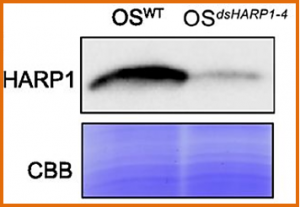
Insects have evolved effectors to conquer plant defense. Most known insect effectors are isolated from sucking insects, and examples from chewing insects are limited. Moreover, the targets of insect effectors in host plants remain unknown. Here, we address a chewing insect effector and its working mechanism. Cotton bollworm (Helicoverpa armigera) is a lepidopteran insect widely existing in nature and severely affecting crop productivity. We isolated an effector named HARP1 from H. armigera oral secretion (OS)

European Union Commissioner for Health & Food Safety Vytenis Andriukaitis spoke about the potential of gene editing during his speech at CRISPRcon, in Wageningen, The Netherlands on June 20-21, 2019. CRISPcon has, for the first time in Europe, gathered a broad selection of diverse voices to discuss the future of CRISPR and related gene editing technologies across a variety of applications in agriculture, health, conservation, and more

According to a perspective article written by Nigel Halford of Rothamsted Research, GM crop developers are currently focused more on seeking permission to use GM crops for feed and food, instead of developing new GM crop varieties. Furthermore, the meaning of GM in the context of crop biotechnology is also not well defined. Because of this, there is an uncertainty on how genome-edited crops should be regulated. Concurrently, Member States impose national bans on GM crops without concrete evidence of safety concerns.
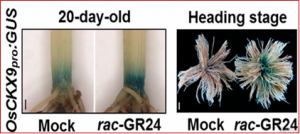
Strigolactones (SLs), a group of terpenoid lactones derived from carotenoids, are plant hormones that control numerous aspects of plant development. Although the framework of SL signaling that the repressor DWARF 53 (D53) could be SL-dependently degraded via the SL receptor D14 and F-box protein D3 has been established, the downstream response genes to SLs remain to be elucidated. Here we show that the cytokinin (CK) content is dramatically increased in shoot bases of the rice SL signaling mutant d53.
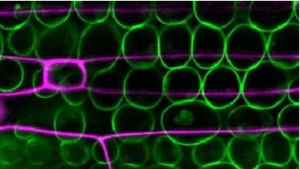
A new study led by scientists at The University of Sheffield's Institute for Sustainable Food has discovered how plants create networks of air channels, the lungs of the leaf, to transport carbon dioxide (CO2) to their cells. The scientists used genetic manipulation techniques to reveal that when plants have more stomata, it forms more airspace. The channels act like bronchioles – the tiny passages that carry air to the exchange surfaces of human and animal lungs.