


Multiplexed CRISPR base editing enables pulse-activated irreversible biocontainment of engineered bacteria Open Access
Sung Won Cho, TaeHyun Kim, Jina Yang, Gibyuck Byun, Sang Woo Seo
Nucleic Acids Research, Volume 54, Issue 8, 8 May 2026, gkag422, https://doi.org/10.1093/nar/gkag422
Abstract
The environmental and therapeutic application of genetically engineered microorganisms necessitates the development of robust, irreversible biocontainment systems. In this study, we present an eEGM (editing-driven essential gene multiplex inactivation) module that utilizes CRISPR-mediated cytidine base editing to induce permanent self-killing via a single transient induction. By targeting the start codons of essential genes, we achieved an irreversible translational blockade that avoids the fitness costs associated with basal toxicity in nuclease-based systems. Multiplexed targeting of non-redundant essential loci (holA, ftsB, and dfp) yielded escape frequencies at or below the NIH guideline criterion (10−8) within 1 h of pulse induction. Furthermore, the eEGM system exhibited robust functional orthogonality and portability across laboratory, industrial, and therapeutic Escherichia coli strains, including MG1655, W3110, and Nissle 1917, without detectable interference with heterologous protein expression. This work establishes base editing as a cleavage-free CRISPR effector for pulse-activated, irreversible biocontainment and provides a practical framework for safer deployment of engineered microbes.
See https://academic.oup.com/nar/article/54/8/gkag422/8666730?login=false
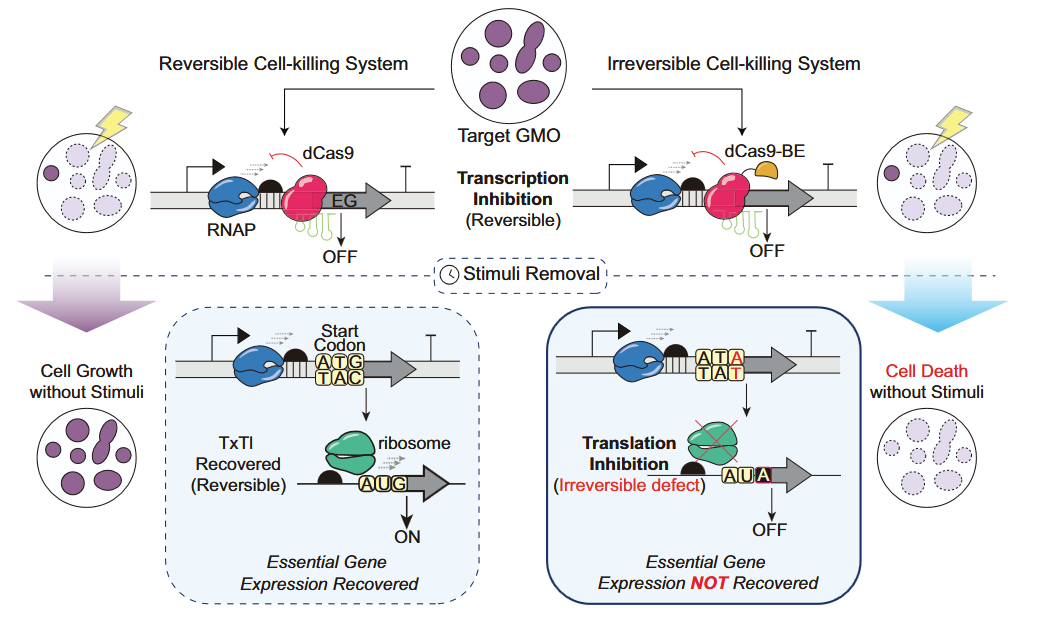
Figure 1. Conceptual framework of irreversible biocontainment using CRISPR-mediated BE. Schematic representation of the reversible and irreversible cell-killing strategies by targeting essential genes (EG). Conventional dCas9-driven cell repression (interference-based Essential Gene targeting, iEG) requires continuous effector occupancy, making it susceptible to growth recovery if the effector expression is removed. In contrast, editing-mediated essential gene targeting (eEG) utilizes a cytidine BE to induce a permanent genetic transition (C-to-T), leading to irreversible translational defect of the target gene. Blue, pink, yellow, and green components denote RNA polymerase, dCas9, cytidine deaminase, and ribosome, respectively. Solid cells indicate viable populations, whereas dotted cells represent non-viable cells.
Views: 232