


Targeted knockout of a host peroxisomal peptidase confers field resistance to maize lethal necrosis
Mark Jung, Zhengyu Wen, Sabrina Humbert, Fengzhong Lu, Alyssa DeLeon, Lisa Marshall, Craig Hastings, Heather Cartwright, Katherine Thilges, Ning Wang, Kassandra Breckenridge, Emily Wu, Larisa Ryan, Kevin Fengler, Kevin Simcox, Shawn Thatcher, Victor Llaca, Grace Woollums, Jeffry Sander, Deping Xu, Mary Beatty, Kent Brink, Maria Fedorova, Mark Jones, Erik Ohlson, L. M. Suresh, Yoseph Beyene, Michael Olsen, Veronica Ogugo, Amos Alakonya, Ann Murithi, Stephen Mugo, James Karanja, Prasanna Boddupalli, Kevin Pixley, Marc Albertsen, Todd Jones, Robert Meeley, Neal Gutterson, Barbara Mazur, and Kanwarpal S. Dhugga
Significance
Maize lethal necrosis (MLN) is a serious viral disease threatening food security in East Africa. We found a previously unknown mechanism by which the virus exploits a specific maize peroxisomal peptidase to form replication compartments. This peptidase constitutes a critical genetic vulnerability. Its elimination using CRISPR-Cas technology confers robust MLN resistance. The edited elite African maize lines remain agronomically identical to their unedited counterparts in the absence of the disease. This targeted strategy provides an efficient, accelerated route to protect crop yields against the MLN threat, thereby safeguarding the livelihoods of vulnerable smallholder farmers.
Abstract
Maize lethal necrosis (MLN) is a severe disease caused by the combined infection of maize chlorotic mottle virus (MCMV) and a potyvirus, most often sugarcane mosaic virus (SCMV). This disease seriously threatens food security across sub-Saharan Africa (SSA). We investigated a major-effect quantitative trait locus for resistance on chromosome 6, named the maize lethal necrosis susceptibility locus 1 (qMLNS1), derived from the Thai line KS23-6. Fine mapping and CRISPR-Cas9 editing of the candidate genes within the narrowed 105 kb interval revealed a peroxisomal peptidase as the underlying cause of susceptibility. Confocal microscopy confirmed the localization of the MLNS1 protein within peroxisomes. Targeted knockout of the Mlns1 gene in the susceptible elite line CML536 from SSA conferred resistance comparable to KS23-6 in field trials conducted in Naivasha, Kenya. This knockout specifically blocked MCMV accumulation without affecting SCMV. The edited lines showed no yield penalty or agronomic defects under disease-free conditions. Our findings uncover a mechanistic link between a peroxisomal enzyme and viral susceptibility. They also establish a rapid, scalable gene editing strategy for incorporating MLN resistance into elite germplasm, offering a model for combating similar viral diseases in staple crops globally.
See https://www.pnas.org/doi/10.1073/pnas.2535202123
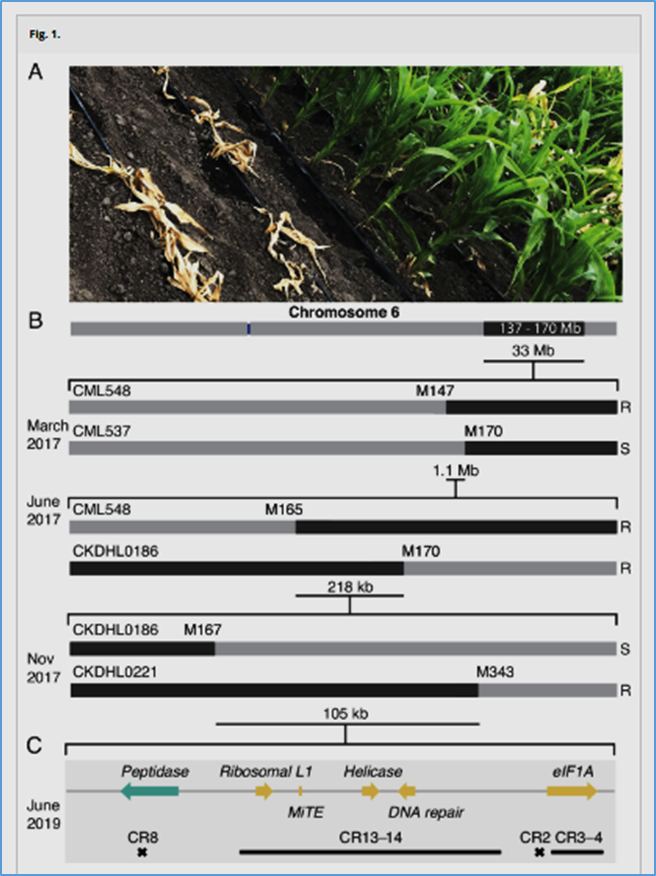
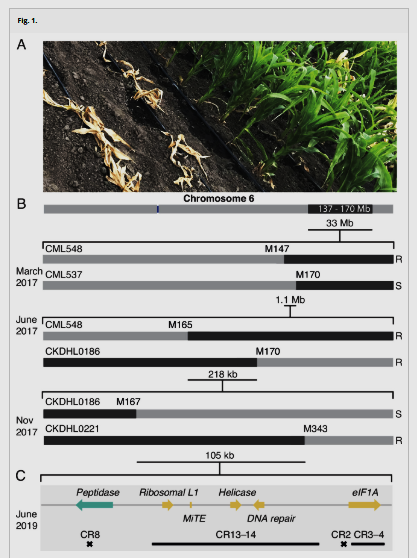
Figure 1:
Fine mapping of QTL for resistance to MLN and identification of causal gene. (A) MLN-susceptible inbred line CML511 without (Left) and with the KS23-6 QTL (Right) after MLN inoculation in Naivasha, Kenya. (B) Narrowing of the genetic interval in successive rounds of phenotyping and genotyping in maize populations. Dark bars represent the KS23-6 genome; lighter bars represent susceptible, recurrent parents. R, resistant; S, susceptible. (C) The 105 kb interval with annotated subregions and CRISPR (CR) designs to identify the causal subregion for MLN resistance. CR with a single number denotes one guide-RNA for introducing mutations and a range denotes flanking guides for target region dropout. Crosses represent frameshift mutations and bars represent dropouts.
Views: 144