


Integration of Ty-1/Ty-3 and Ty-6 confers improved and durable resistance to highly pathogenic begomoviruses in tomato
Moeno Shimoide, Misaki Nakajima, Nadya Syafira Pohan, Elly Kesumawati & Sota Koeda
Euphytica 30 March 2026, Volume 222, article number 67
Abstract
Begomoviruses are among the most destructive pathogens of tomato worldwide, and the introgression of Ty-genes in tomato is a key strategy for disease management. However, a single Ty-gene often provides incomplete protection against highly virulent begomovirus species. Here, commercial tomato cultivars and a series of breeding lines previously developed by the World Vegetable Center (WorldVeg) were inoculated with one of three begomovirus species that differed in virulence. The presence of Ty-1, Ty-2, Ty-3, Ty-3a, ty-5, and Ty-6 was validated using in-gene markers. Tomato plants carrying only Ty-2 were susceptible to all viruses, whereas those with Ty-1 were resistant to a less-virulent begomovirus, but susceptible to more-virulent viruses. Among the seven WorldVeg’s breeding lines, AVTO1919 (Ty-1/Ty-1, Ty-6/Ty-6) and AVTO1920 (Ty-3/Ty-3, Ty-6/Ty-6) were symptomless in most cases and the lowest viral DNA accumulation across all lines tested indicating strong begomovirus resistance. The resistance of AVTO1919 was comparable to or greater than that of AVTO1701, a line homozygous for Ty-2, Ty-3, ty-5, and Ty-6. Furthermore, F₁ plants derived from crosses between AVTO1919 or AVTO1920 and susceptible Moneymaker exhibited reduced disease tolerance, indicating the resistance conferred by Ty-1 or Ty-3 and Ty-6 is incomplete dominance. These results demonstrate that Ty-1/Ty-3 and Ty-6 integration in homozygous states can provide robust and broad-spectrum resistance to begomoviruses and is a valuable strategy for breeding durable resistant tomato cultivars.
See https://link.springer.com/article/10.1007/s10681-026-03711-y
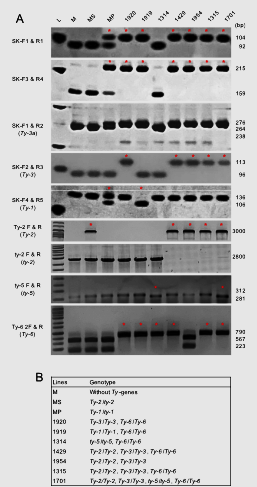
Figure 2: Validation of Ty-1, Ty-2, Ty-3, Ty-3a, ty-5, and Ty-6 presence in tomato cultivars and lines using allele specific in-gene markers. A The susceptibility (S) allele and Ty-1/Ty-3/Ty-3a resistance (R) alleles were distinguished using marker SK-F1 and R1 (S: 92 bp, R: 104 bp) and marker SK-F3 and R4 (S: 159 bp, R: 215 bp). The susceptibility allele (264 bp), Ty-1/Ty-3 (276 bp), and Ty-3a (238 bp) were distinguished using marker SK-F1 and R2. The susceptibility/Ty-1/Ty-3a alleles (96 bp) and Ty-3 (113 bp) were distinguished using marker SK-F2 and R3. The susceptibility/Ty-3/Ty-3a alleles (136 bp) and Ty-1 (106 bp) were distinguished using marker SK-F4 and R5. The Ty-2 resistance allele (approximately 3000 bp) was distinguished using marker Ty-2 F and R and the susceptibility allele (approximately 2800 bp) was distinguished using marker ty-2 F and R. The susceptibility (S) Ty-5 allele and resistance (R) ty-5 alleles were distinguished using marker ty-5 F and R (S: 312 bp, R: 31 + 281 bp). The susceptibility (S) ty-6 allele and resistance (R) Ty-6 alleles were distinguished using marker Ty-6 F and R (S: 223 + 567 bp, R: 790 bp). Asterisks indicate resistance alleles. L, DNA ladder; M, begomovirus-susceptible tomato Momotaro; MS, TYLCV-resistant tomato Momotaro Sakura; MP, TYLCV-resistant tomato Momotaro Peace. B Summary of genotyped Ty-gene combinations. Details on molecular markers and PCR conditions are in Table S2 and S3
Views: 106