


A magnesium efflux transporter required for seed development and eating quality in rice
Sheng Huang, Kiyosumi Hori, Naoki Yamaji, Yuma Yoshioka, Min Ning, Yu Nagaya, Takaaki Miyaji, Namiki Mitani-Ueno, Shin-ichiro Inoue, June-Sik Kim, Miho Kashino, and Jian Feng Ma
PNAS; April 22 2026; 123 (17) e2536813123; https://doi.org/10.1073/pnas.2536813123
Significance
Magnesium (Mg) is an essential element for both plants and humans. As a staple food, rice represents a major dietary source of Mg, yet the mechanism underlying Mg loading into grain remains unclear. In this study, we identified a Mg transporter, OsMGR2, which localizes to the plasma membrane and functions as an efflux transporter required for the seed development and eating quality in rice. Depending on its expression, OsMGR2 performs multiple roles; facilitating root-to-shoot Mg translocation, mediating phloem-to-xylem Mg transfer at nodes for preferential distribution to the most active leaf, and exporting Mg from maternal vascular tissues of the caryopsis to the grain.
Abstract
As a staple food for half the world’s population, rice is an important dietary source of magnesium (Mg), an essential mineral for human health. Enhanced Mg accumulation in rice grains has also been linked to eating quality. However, the mechanisms underlying Mg transport to the grains remains poorly understood. Here, we report that OsMGR2, a member belonging to Magnesium Release (MGR) family, is required for Mg accumulation in rice grains. OsMGR2 encodes a plasma membrane-localized transporter that mediates Mg efflux. OsMGR2 is constitutively and highly expressed in the stele tissues of roots, the phloem region of both enlarged and diffused vascular bundles in nodes, and the ovular vascular trace of caryopses. Knockout of this gene results in decreased root-to-shoot translocation and altered distribution of Mg to different organs; less Mg is allocated to the second newest leaf with high Mg requirement for active photosynthesis. The osmgr2 mutants exhibit decreased Mg accumulation in the grain, which are smaller, lighter, and shriveled, but show increased accumulation in the husk. The eating quality of the mutant grains is significantly decreased compared with the wild-type rice. These results indicate that OsMGR2 plays multiple roles within the rice; facilitating the root-to-shoot Mg translocation, mediating phloem-to-xylem Mg transfer at nodes for preferential distribution to the most active leaf, and exporting Mg from maternal vascular tissues of the caryopsis to the grains, processes essential for grain development and eating quality in rice.
See https://www.pnas.org/doi/10.1073/pnas.2536813123
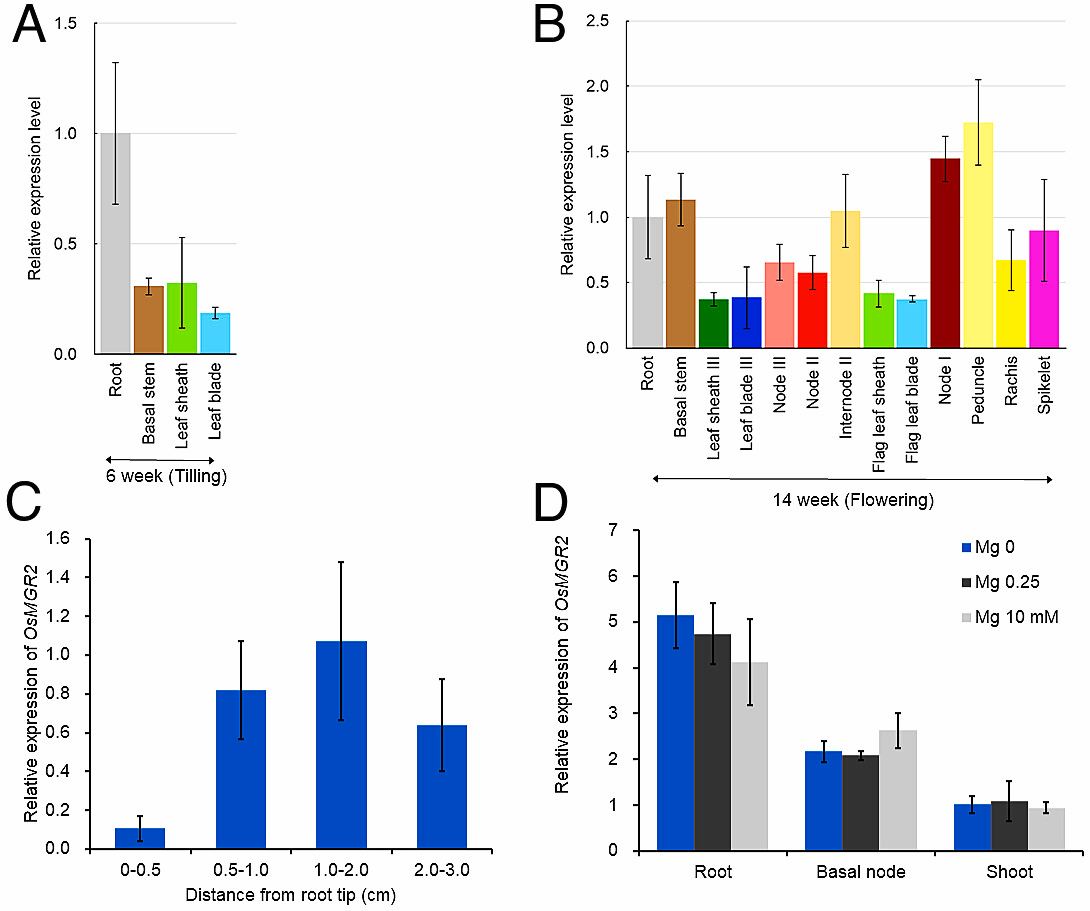
Figure 1:
Expression pattern of OsMGR2. (A and B) Growth stage- and organ-dependent expression of OsMGR2. Samples of various organs were collected at vegetative (A) and reproductive (B) stages from rice grown in the field. (C) Spatial expression pattern of OsMGR2 in roots. Different root segments, as indicated, were collected from 5-d-old seedlings. (D) Response of OsMGR2 expression to different Mg concentrations. 25-d-old seedlings (cv. Nipponbare) were exposed to a solution containing 0, 0.25, or 10 mM Mg for 7 d. Roots, shoot basal regions, and shoots were then sampled for RNA extraction. The expression level of OsMGR2 was determined by RT-qPCR with Histone H3 used as an internal control. Expression is shown relative to root (A and B), root segment of 1.0 to 2.0 cm (C), and shoot under 0 mM Mg condition (D). Data represent means ± SD of three (A and B) or four (C and D) biological replicates (n = 3 or 4).
Views: 185