


Beyond IbMYB1: Identification and Characterization of Two Additional Anthocyanin MYB Activators, IbMYB2 and IbMYB3, in Sweetpotato
Jian Wang, Zhuo Chen, Yang Lu, Xiaobei Zhang, Yizhao Chen, Xiangrui Li, Yi Liu, Yonghua Liu, Sunjeet Kumar, Zhixin Zhu, Guopeng Zhu
Plants (Basel); 2025 Sep 18; 14(18):2896. doi: 10.3390/plants14182896.
Abstract
Sweetpotato displays diverse purple pigmentation due to anthocyanin accumulation. While current research on the underlying MYB activators has focused on IbMYB1 in purple-fleshed tubers, the color diversity suggests the involvement of other MYB activators. We previously identified IbMYB2 and IbMYB3 in leaf coloration. Here, we explored the chromosomal localization, phylogeny, and evolutionary scenario of IbMYB1/2/3 using four Ipomoea genomes. IbMYB1/2/3 are located adjacently as an anthocyanin MYB gene cluster, likely resulting from tandem duplications. All three IbMYBs induced anthocyanins in tobacco and activated the promoters of the key anthocyanin pathway genes IbCHS-D and IbDFR-B. Expression analysis across sweetpotato varieties indicated that IbMYB1 dominates purple tuber flesh, whereas IbMYB2/3 contribute to leaf and tuber skin coloration. Overexpression of IbMYB1/2/3 in sweetpotato all induced purple fibrous roots. Transcriptomics of IbMYB2-OX fibrous roots revealed upregulation of the entire anthocyanin pathway genes. Among the most highly upregulated transcription factors were IbMYB27 and IbHLH2. An inhibitory effect induced by IbMYB27 likely accounts for the faint pigmentation in IbMYB2-OX storage roots. The role of IbMYB2/3 in fine-tuning sweetpotato's purple pigmentation was highlighted. This study supplements previous work on IbMYB1, providing valuable insights into the intricate anthocyanin regulatory network and supporting sweetpotato breeding efforts for improved nutritional and aesthetic qualities.
See https://pubmed.ncbi.nlm.nih.gov/41012047/
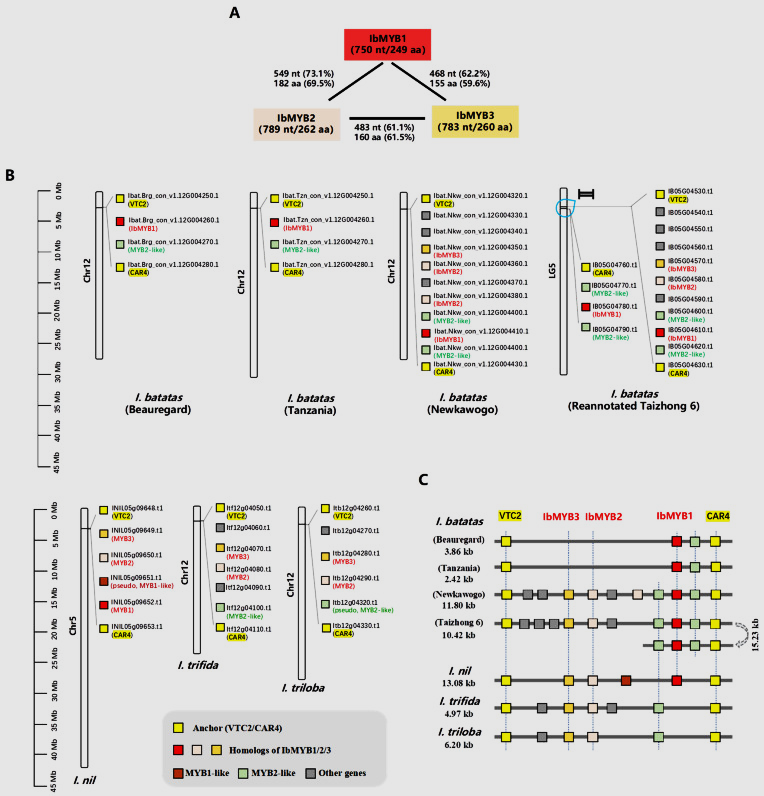
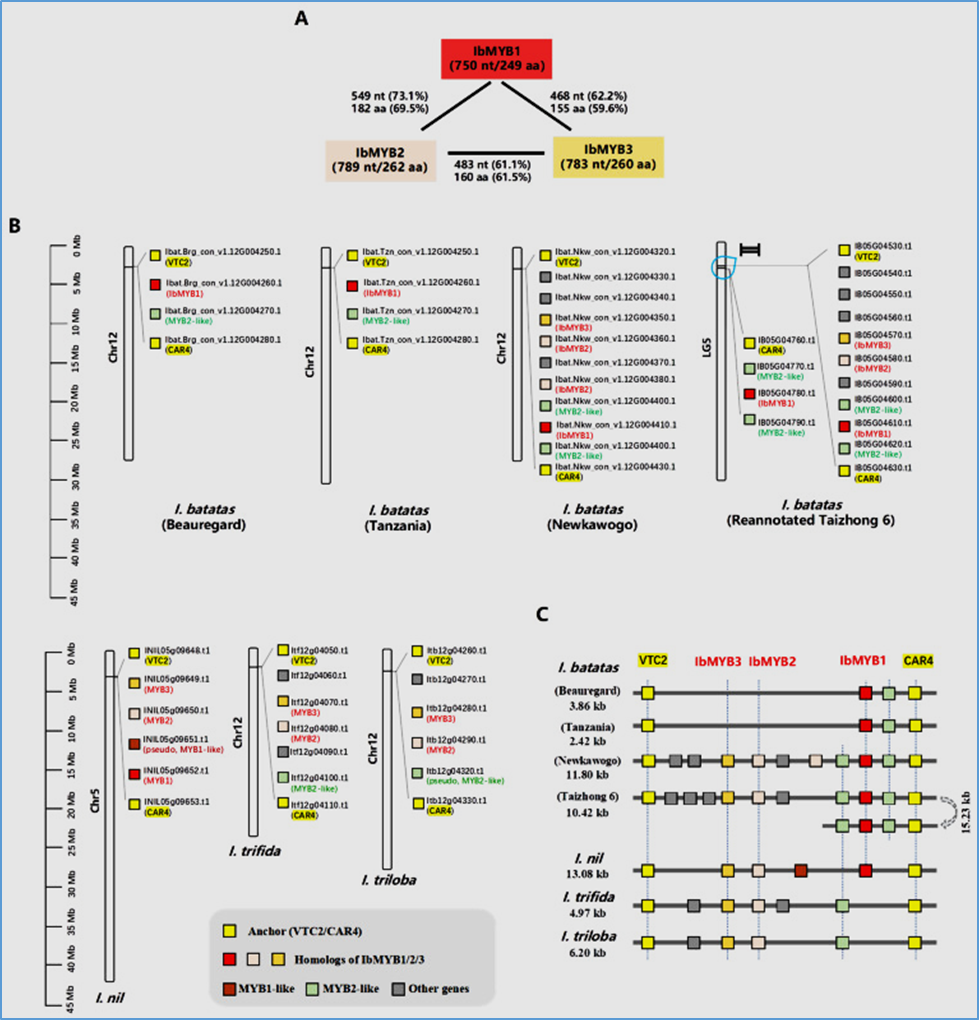
Figure 1. Sequence similarity and chromosomal localization of IbMYB1, IbMYB2, and IbMYB3. (A) Nucleic acid and protein sequence similarity among the CDSs of three IbMYBs. (B) Chromosomal distribution of anthocyanin MYB gene clusters in sweetpotato and related Ipomoea species. Yellow-highlighted VTC2 and CAR4 mark the conserved boundaries of each cluster. (C) Schematic diagrams of the anthocyanin-related MYB gene clusters in Ipomoea species. Cluster lengths are indicated. Colored blocks denote gene types: IbMYB1/2/3 homologs (red to pink), IbMYB1-like (brown), IbMYB2-like (green), and unrelated genes (gray). Homologous genes are connected by dashed lines. A segmental inversion duplication is shown in the IbMYB1-containing region of I. batatas cv. “Taizhong 6”.
Views: 124