


A candidate gene marker at the red kidney color locus (Rk) enables the development of slow-darkening pink beans
Caroline Osborne, Phillip E. McClean, Alvaro Soler Garzón, Atena Oladzad-Nejad, Rian Lee, Phillip N. Miklas, Juan M. Osorno, Justin D. Faris & Jayanta Roy
Theoretical and Applied Genetics; 20 May 2026; vol. 139; article157
Key message
Identification of Rk candidate gene and diagnostic markers enabled precise introduction of the slow‑darkening (SD) allele into pink beans, producing stable SD phenotypes and expanding breeding utility across market classes.
Abstract
Common bean (Phaseolus vulgaris L.) is a globally important and nutritious crop with diverse market classes. Multiple genes control the seed coat color and patterns that characterize these market classes. Therefore, understanding the genetic control of seed coat color is critical for breeding purposes, especially when making crosses among different market classes. One such gene is Rk, the “red kidney” color gene. The recessive rkp allele controls the characteristic color expression of the pink market class. Through GWAS analysis, sequencing candidate genes across multiple market classes, genetic mapping, and phylogenetic analysis, we determined the gene model PvUI111.02G213800, which encodes anthocyanidin reductase, is the most likely candidate for the Rk gene. Pink beans, along with several other market classes, suffer from postharvest seed coat darkening, a quality issue that causes significant economic losses and reduces consumer appeal and nutritional value. The recessive Psd allele present in some pinto genotypes imparts a “slow-darkening” (SD) phenotype. To introduce the Psd allele into the pink market class, crosses were made between three pink beans and the SD pinto cultivar ND Palomino. Among 2240 F2 plants screened using PACE markers targeting multiple genes (Psd, rkp, and pi) controlling pink color and slow-darkening, 32 individuals exhibited the desired alleles and SD pink genotype. The SD phenotype was verified via ultra-violet (UV) testing (λ = 254 nm), and field trials of F5 generation lines demonstrated their phenotypic stability. Parallel efforts are underway to incorporate the SD trait into light red kidney and cranberry beans, broadening its utility across market classes.
See https://link.springer.com/article/10.1007/s00122-026-05256-z
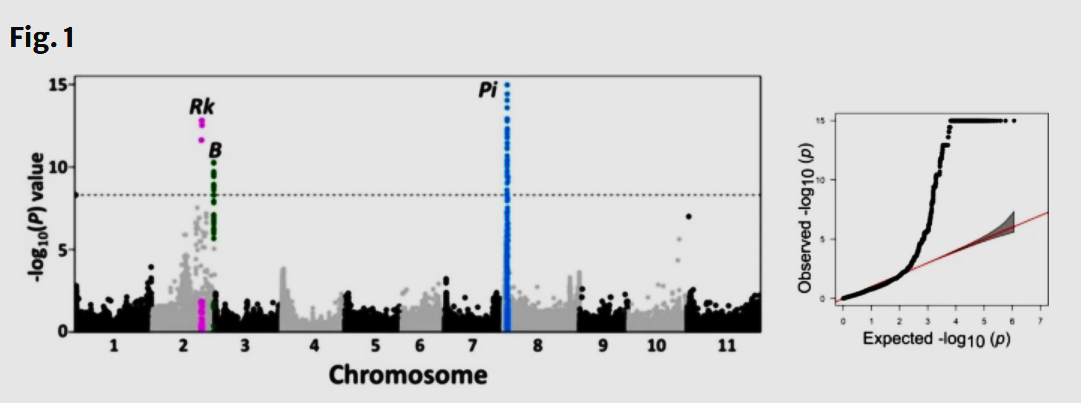
Figure 1
Manhattan plot and Q-Q plot for the GWAS of red seed coat color. The Manhattan plot shows a strong peak for Rk in chromosome 2. Associations were also found for Pi and B. The dotted line represents the 0.01% significance threshold
Views: 114