


Intra species dissection of Phytophthora capsici resistance in black pepper
Yupeng Hao, Rui Fan, Yongyan Zhao, Ke Nie, Luyao Wang, Ting Zhao, Zhiyuan Zhang, Xiaoyuan Tao, Hongyu Wu, Jiaying Pan, Chaoyun Hao, Xueying Guan
J Adv Res.; 2025 Aug: 74:121-136. doi: 10.1016/j.jare.2024.10.015.
Abstract
Introduction: Black pepper, a financially significant tropical crop, assumes a pivotal role in global agriculture for the major source of specie flavor. Nonetheless, the growth and productivity of black pepper face severe impediments due to the destructive pathogen Phytophthora capsici, ultimately resulting in black pepper blight. The dissecting for the genetic source of pathogen resistance for black pepper is beneficial for its global production. The genetic sources include the variations on gene coding sequences, transcription capabilities and epigenetic modifications, which exerts hierarchy of influences on plant defense against pathogen. However, the understanding of genetic source of disease resistance in black pepper remains limited.
Methods: The wild species Piper flaviflorum (P. flaviflorum, Pf) is known for blight resistance, while the cultivated species P. nigrum is susceptible. To dissecting the genetic sources of pathogen resistance for black pepper, the chromatin modification on H3K4me3 and transcriptome of black pepper species were profiled for genome wide comparative studies, applied with CUT&Tag and RNA sequencing technologies.
Results: The intraspecies difference between P. flaviflorum and P. nigrum on gene body region led to coding variations on 5137 genes, including 359 gene with biotic stress responses and regulation. P. flaviflorum exhibited a more comprehensive resistance response to Phytophthora capsici in terms of transcriptome features. The pathogen responsive transcribing was significant associated with histone modification mark of H3K4me3 in black pepper. The collective data on variations of sequence, transcription activity and chromatin structure lead to an exclusive jasmonic acid-responsive pathway for disease resistance in P. flaviflorum was revealed. This research provides a comprehensive frame work to identify the fine genetic source for pathogen resistance from wild species of black pepper.
See https://pubmed.ncbi.nlm.nih.gov/39442874/
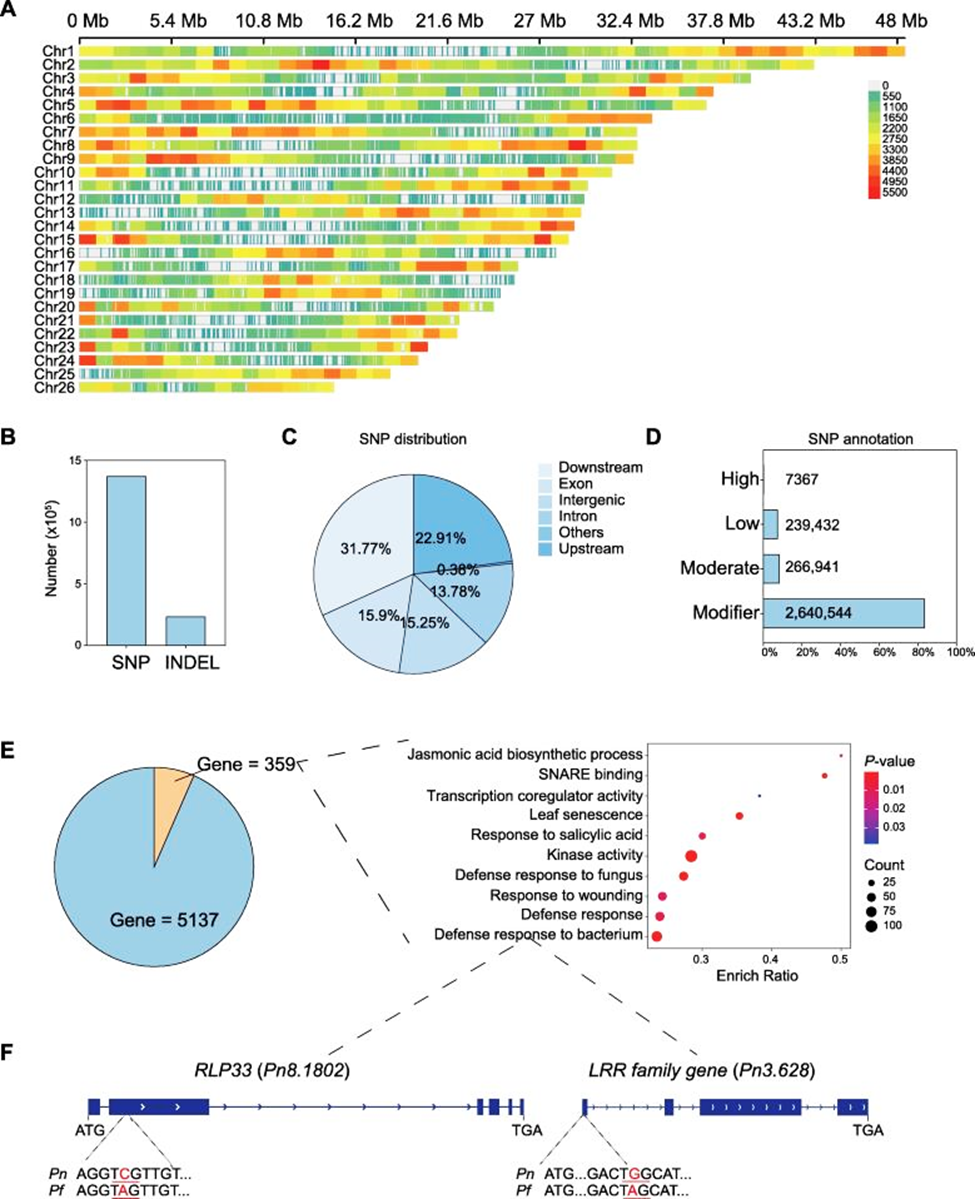
Figure 2:
The genomic differences on transcribed region in disease resistance in Piper flaviflorum.
A: The distribution of SNPs on chromosomes of Pf. The heatmap shows the density of SNPs. B: The number of SNPs and INDELs of Pf. C: Pie chart of the SNPs distribution by genes’ region. Different color blocks represent different regions. D: SNPs annotation of the effects by impact. HIGH: The variant is assumed to have high (disruptive) impact in the protein, probably causing protein truncation, loss of function or triggering nonsense mediated decay. Moderate:A non-disruptive variant that might change protein effectiveness. Low: Assumed to be mostly harmless or unlikely to change protein behavior. Modifier: Usually non-coding variants or variants affecting non-coding genes, where predictions are difficult or there is no evidence of impact. E: Pie chart and the GO terms of genes related to disease resistance in high-impact level genes. F: The SNP and gene structure of the candidate genes. Pn represents Piper nigrum and Pf represents Piper flaviflorum.
Views: 143