


Genomic basis underlying alternative transcripts-mediated drought tolerance in maize
Shulin Hao, Suwen Han, Zhenghua He, Nannan Dou, Zhijia Yu, Xiangguo Liu, Xingrong Wang, Yanjun Zhang, Mingqiu Dai, Xiaopeng Sun
Genome Biol.; 2026 Jan 20. doi: 10.1186/s13059-026-03939-w.
Abstract
Background: Drought is a major abiotic stress that affects the growth and yield of maize. Alternative transcripts are crucial in abiotic stress responses in plants. However, the genetic basis of alternative transcripts mediated drought response in maize remains largely unknown.
Results: We characterize thousands of drought-responsive genes based on the transcriptomic dataset of 197 maize association population under well-watered and drought-stressed conditions. We perform mRNA profiling of the seedlings at six-leaf stage under drought stress. Through co-expression analysis and experimental validation, we identify a splicing associated factor ZmMBF1, which positively regulates drought response in maize. We also detect thousands of alternative transcript QTLs (atQTLs) and expression QTLs (eQTLs), some of them are linked with stress responsive genes under well-watered and drought-stressed conditions, respectively. Co-localization analysis demonstrates that most of the natural variations in alternative transcripts and gene expression levels are regulated independently by different sequence variations. Variations in transposons, inverted repeats, and UA-rich sequences are significantly associated with atQTLs, suggesting important roles of these variations in regulating alternative transcripts and drought response. As proof of concept, we demonstrate that variations in UA-rich sequence of ZmPYL8 intron regulate drought resistance by affecting ZmPYL8 alternative transcripts, generating two transcripts that function antagonistically in regulating ABA signaling and drought response.
Conclusions: This study reveals the response of maize alternative transcripts to drought at the population level, illustrating the pivotal roles of intron variations in regulating maize alternative transcripts and drought response. It also provides genetic resources and theoretical basis for breeding maize with drought-resistance.
See: https://pubmed.ncbi.nlm.nih.gov/41559689/
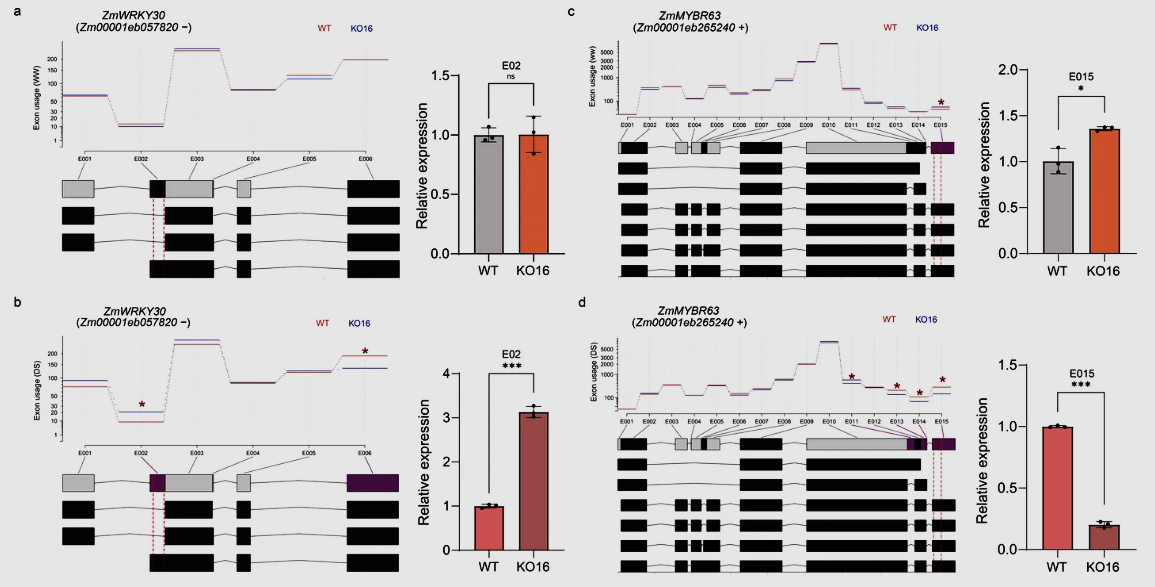
Figure 3: ZmMBF1 influences alternative splicing under drought stress conditions. a-d Examples of genes with differential exon usages. The drought-responsive genes ZmWRKY30 (a, b) and ZmMYBR63 (c, d) were used as examples. The results of differential exon usages from the mRNA sequencing are shown on the left, and the corresponding RT-qPCR results are shown on the right. Leaves of ZmMBF1 KO16 and wild-type plants were collected under WW (a, c) and DS (b, d) condition for mRNA sequencing and RT-qPCR analysis. Exons shown in purple—with significantly differential usage between KO16 and wild-type plants—are marked with an asterisk. The red dashed line represents the location of the primers. Data are presented as mean ± SD (n ≥ 3). Significant differences are indicated as *, P < 0.05; ***, P < 0.001 (Student’s t-test).
Views: 201