


Functional Analysis of OsDRP2B in Rice Root Development
Lihuiying Jia, Zhiqiang Guo, Yunyan Hua, Qi Zhu, Fengyi Zhou, Qiuping Li, Xu Li, Mengsha Li, Mengting Wang, Yujie Chen, Xiaofei Wang, Tao Ma, Wona Ding
Plants (Basel); 2026 Jan 21; 15(2):313. doi: 10.3390/plants15020313.
Abstract
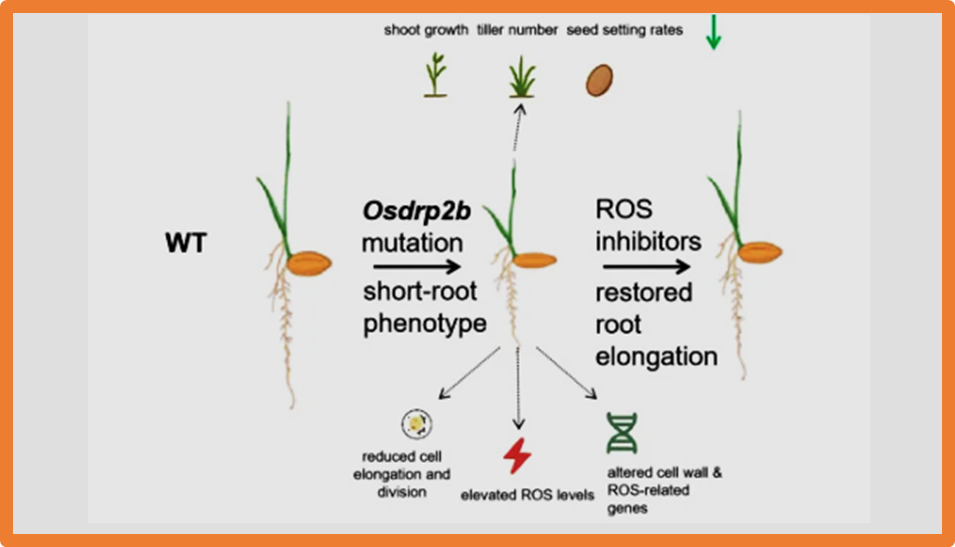
Rice (Oryza sativa L.) root system plays a critical role in water and nutrient uptake, influencing overall plant growth and crop yield. In this study, we characterized the Osdrp2b mutant, which exhibits a short-root phenotype and was identified through map-based cloning. The Osdrp2b mutation was traced to the gene encoding a dynamin-related protein, and the mutant displayed reduced cell elongation and impaired cell division in the root tip. Further analysis revealed that ROS (reactive oxygen species) accumulation was elevated in the mutant roots, and treatment with ROS inhibitors restored root elongation in the Osdrp2b mutant, indicating that altered ROS homeostasis is associated with the phenotype. Transcriptomic analysis highlighted the differential expression of genes involved in cell wall organization and hydrogen peroxide catabolism. Agronomic evaluations of the Osdrp2b mutant demonstrated compromised shoot growth, reduced tiller number, and lower seed setting rates, indicating the impact of the mutation on rice yield. Overall, these results suggest that OsDRP2B is involved in regulating root growth, potentially through effects on ROS homeostasis and associated signaling networks. These findings provide a basis for future studies on improving rice root development and agronomic performance.
See https://pubmed.ncbi.nlm.nih.gov/41600120/
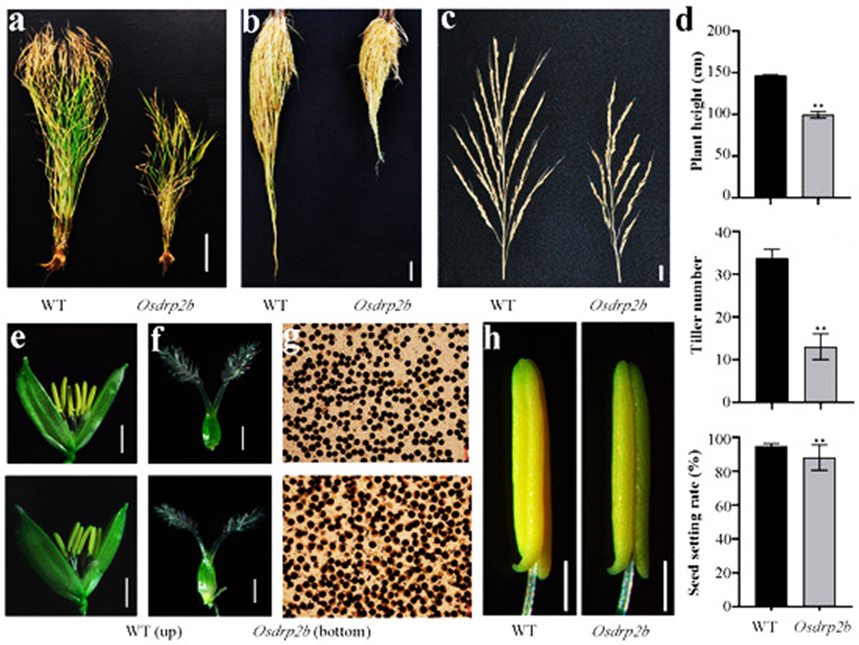
Figure 5. Agronomic traits and reproductive organ phenotypes of the Osdrp2b mutant. (a) Mature WT and Osdrp2b plants grown under field conditions. Scale bar = 20 cm. (b) Roots of mature WT and Osdrp2b. Scale bar = 2 cm. (c) Spikes of WT and Osdrp2b from field planting. Scale bar = 2 cm. (d) Agronomic traits at the maturation stage, including plant height, effective tiller number, stem thickness, and seed setting rate of WT and Osdrp2b. Values are means ± SE. Statistical significance was determined using Student’s t-test, and asterisks (**) indicate a significant difference from WT (p < 0.01). (e) Florets of WT (top) and Osdrp2b (bottom). Scale bar = 1 mm. (f) Pistils of WT (top) and Osdrp2b (bottom). Scale bar = 500 μm. (g) I2-KI staining of pollen from WT (top) and Osdrp2b (bottom). (h) Stamens of WT and Osdrp2b. Scale bars = 100 μm.
Views: 136