


News & Events
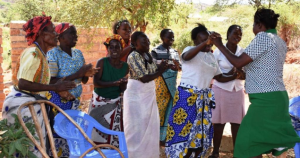
Mary Kathini pulls me into a hug and, with a high-five, sits me down in the shade amid makeshift seats of rocks and tree stumps. Under the harsh equatorial sun of Ntunjia village, this is a warm welcome that brings cheerful hopes and much conversation. As you soak in the chatter and the enthusiasm, the women – into whose circle I am grateful to be included – point to Mary to answer most of the questions. “She’s our leader” they say – but they make sure their views are also heard every now and then.
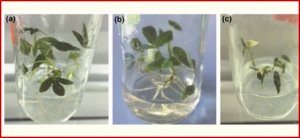
Cassava mosaic disease is caused by cassava mosaic begomoviruses (CMBs) and can result in crop losses up to 100% in cassava (Manihot esculenta) in Tanzania. We investigated the efficacy of chemotherapy and thermotherapy for elimination of East African cassava mosaic virus (EACMV) of Tanzanian cassava. In vitro plantlets from EACMV-infected plants obtained from coastal Tanzania were established in the greenhouse. Leaves were sampled from the plants and tested to confirm the presence of EACMV
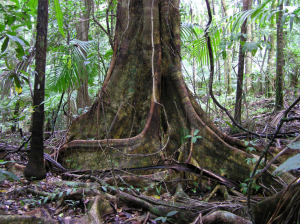
In PNAS, Lister and Garcia (1) report declines in abundances of understory arthropods and lizards between 1976 and 2012 and claim similar declines in populations of arthropods, frogs, and insectivorous birds based on data from the Luquillo Long-Term Ecological Research project (LUQ). Their conclusion, that increasing temperature has led to a collapse of the food web, has attracted considerable attention from public media,
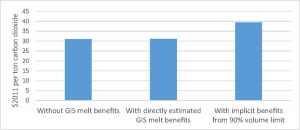
For the last 40 y, economists have worked to put monetary values on environmental amenities to facilitate the cost–benefit analysis (CBA) of alternative policies (1⇓–3). The motivation is simple: Policy choices inevitably require trade-offs. Resources devoted to climate change mitigation are resources not spent on curing diseases, improving education, alleviating poverty, or providing for national defense, not to mention enjoying private comforts and consumption.
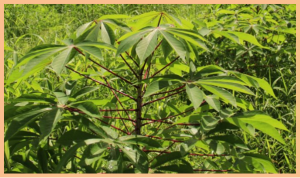
A two-year field experiment was carried out in a randomized complete block design with two replications in 2015/16 and 2016/17 cropping seasons at the National Root Crops Research Institute, Umudike (05° 29'N; 07° 33'E; 122 m above sea level) in Nigeria. The objectives of the study were to assess growth, disease status and yield responses of twenty-eight (28) newly developed high- and low-cyanide cassavagenotypes in low-land humid tropics of Umudike
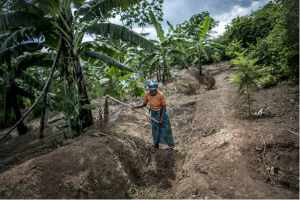
FAO today welcomed a decision by the Council of the Global Environment Facility (GEF) to provide $179 million to support the UN agency's work with countries worldwide at the critical nexus between agriculture and the environment. This includes projects focussed on biodiversity conservation, transboundary water resources management, sustainable land management, highly hazardous pesticide remediation, and climate change adaptation.
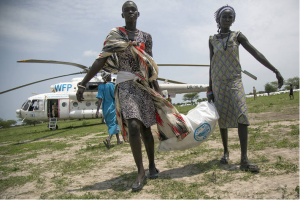
According to the Integrated Food Security Phase Classification (IPC) update released today by the Government of South Sudan in collaboration with the Food and Agriculture Organization of the United Nations (FAO), the United Nations Children's Fund (UNICEF) and the World Food Programme (WFP), an estimated 6.96 million South Sudanese will face acute levels of food insecurity or worse (IPC Phases 3, 4 and 5) by the end of July.

The genetic and molecular analysis of trichome development in Arabidopsis thaliana has generated a detailed knowledge about the underlying regulatory genes and networks. However, how rapidly these mechanisms diverge during evolution is unknown. To address this problem, we used an unbiased forward genetic approach to identify most genes involved in trichome development in the related crucifer species Arabis alpina. In general, we found most trichome mutant classes known in A. thaliana.
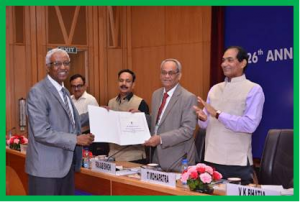
5 June 2019, Delhi, India - Dr. Abdelbagi Ismail, Principal Scientist and IRRI Representative in Africa was presented the prestigious Fellowship of the National Academy of Agricultural Sciences, India as a foreign fellow. The honour is effective January of 2019 and was conferred to Dr. Ismail in a formal ceremony chaired by Dr. Panjab Singh, President of the academy.
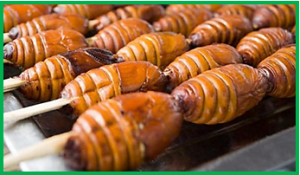
Livestock farming poses environmental harm such as land and water degradation, biodiversity loss, and climate change. Tufts University suggests a toolbox of potential solutions to address this problem. The popular options include shifting to plant-based diets, insect farming, lab-grown meat, and genetically modified animals. In an article in Frontiers in Sustainable Food Systems, Natalie Rubio of Tufts University explains why lab-grown insect meat-fed on GM products for maximum growth, nutrition, and flavor, could be the best green alternative for high volume, nutritious food production.
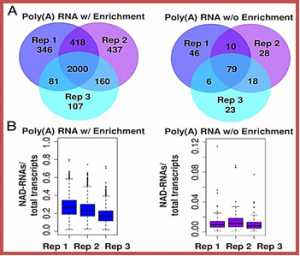
The 5′ end of a eukaryotic mRNA transcript generally has a 7-methylguanosine (m7G) cap that protects mRNA from degradation and mediates almost all other aspects of gene expression. Some RNAs in Escherichia coli, yeast, and mammals were recently found to contain an NAD+ cap. Here, we report the development of the method NAD tagSeq for transcriptome-wide identification and quantification of NAD+-capped RNAs (NAD-RNAs).
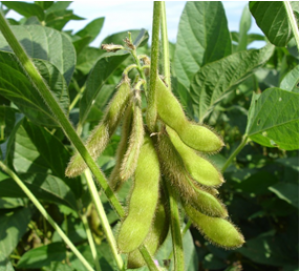
Photosynthesis is an important physiological process in plants. It plays a crucial role in plant growth and development. Vietnam Academy of Science and Technology reports the impact of zerovalent cobalt nanoparticles on the expression of genes linked to photosynthesis in soybean leaves at different growth stages.