


India approves first genome-edited rice varieties
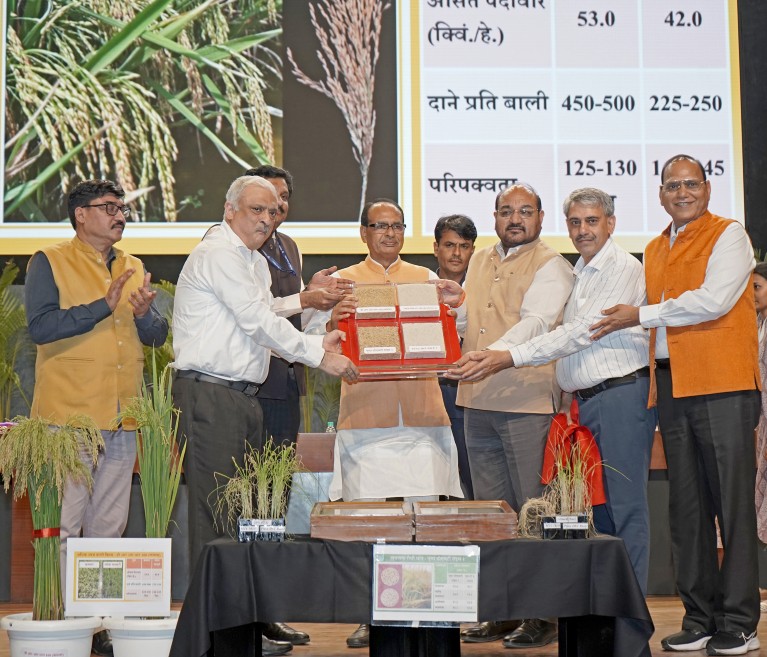
Figure: Agriculture Minister Shivraj Singh Chouhan releasing the CRISPR-Cas9 edited rice varieties. Credit: PIB. Using CRISPR-Cas9, scientists have developed high-yield, stress-tolerant, climate-resilient rice varieties free of foreign DNA
NATURE 2025
India has approved its first genome-edited rice varieties, signaling a shift toward more sustainable, high-performing crops developed without foreign DNA. Unlike genetically modified organisms (GMOs), these new rice lines, created using the CRISPR-Cas9 system, rely on precise gene editing to enhance resilience and productivity.
India's agriculture minister Shivraj Singh Chouhan released the two varieties — Pusa rice DST1 and DRR Dhan 100 — developed by researchers at the Indian Agricultural Research Institute (IARI) and the Indian Institute of Rice Research (IIRR), both under the Indian Council of Agricultural Research (ICAR).
ICAR Director General Mangi Lal Jat called it a historic day in Indian agriculture and said many other gene-edited crop varieties will be released in the coming years. "New agriculture regimes need adapting to new techniques. Old methods won't work in new climate realities," he said. Multiple organsiations and universities in India are currently researching over 10 gene-edited crops such as pulses, oilseeds including mustard, wheat, tobacco, cotton, banana, tomato and tea.
Rajeev Varshney, International Chair of Agriculture & Food Security and Director of the Centre for Crop and Food Innovation at Murdoch University in Australia, said these announcements mark a milestone in agricultural biotechnology and would specifically benefit small-holder farmers and inspire global advancements.
Precision edits
The Pusa Rice DST1, developed by IARI, is engineered for improved drought and salt tolerance. By knocking out a gene responsible for suppressing stress resistance, the scientists achieved plants with reduced stomatal density and water use, alongside improved tillering, grain yield, and salt resilience. Field tests showed significantly higher yields under drought and saline stress compared to the parent MTU1010 variety.
Meanwhile, DRR Dhan 100, created by IIRR, targets the widely cultivated Samba Mahsuri variety. Using CRISPR, researchers edited a cytokinin oxidase gene (OsCKX2), developing a novel allele. The result was a 19% boost in grain yield, earlier maturity by up to 20 days, and better performance under low-fertilizer and drought conditions.
Varshney said with improved stress tolerance and yield, they offer solutions to the challenges of climate change and resource constraints.
Road ahead
The development of these crops follows years of groundwork by Indian researchers, with regulatory support from the Department of Biotechnology (DBT) and scientific input from the National Academy of Agricultural Sciences (NAAS). India's 2022 guidelines exempting certain genome-edited plants from the strict GMO approval process helped accelerate their path to approval.
The two genome-edited lines will now proceed to broader cultivation trials and eventual commercialization, representing what many see as a scalable model for crop innovation in the global south. Devesh Chaturvedi, Secretary of the Department of Agriculture and Farmers Welfare, said the technology was developed domestically and hence can be swiftly delivered to farmers through both public and private sector efforts.
See https://www.nature.com/articles/d44151-025-00078-2
Views: 309