


Autoactive MtDMI1 Reprogrammes Immunity and Development in Tomato via Ethylene Signalling
Plant Biotechnology Journal (6 January 2026)
Liu et al.
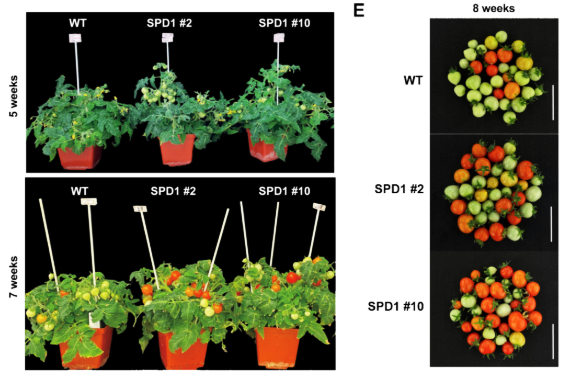
The Common Symbiosis Signalling Pathway (CSSP) underpins interactions between plants and microbes, yet its potential for crop improvement remains underexplored. Here, we investigated the gain-of-function mutant SPD1 (MtDMI1S760N), which constitutively activates the symbiotic signalling pathway in Medicago truncatula, by expressing it in tomato (Solanum lycopersicum cv. Micro-Tom). Heterologous expression of SPD1 constitutively activated ethylene biosynthesis, leading to broad-spectrum resistance against fungal, bacterial, and vascular pathogens. Beyond immunity, SPD1 reprogrammed tomato development, accelerating seed germination, flowering, and fruit ripening, while reducing arbuscular mycorrhizal colonisation and primary root growth. Transcriptome analysis revealed constitutive activation of ethylene biosynthesis and immune marker genes, consistent with increased ethylene emission and amplified ROS and MAPK response to both pathogenic and symbiotic elicitors. Ethylene inhibitor AVG reversed both immune activation and root defects, confirming a central role of ethylene signalling in SPD1-mediated reprogramming. Our findings show that an autoactivate legume symbiotic component can reprogramme defence and development traits in a non-legume via ethylene signalling, highlighting SPD1 as a promising tool for breeding early-maturing and disease-resistance crops.
See https://onlinelibrary.wiley.com/doi/full/10.1111/pbi.70533
Views: 100